
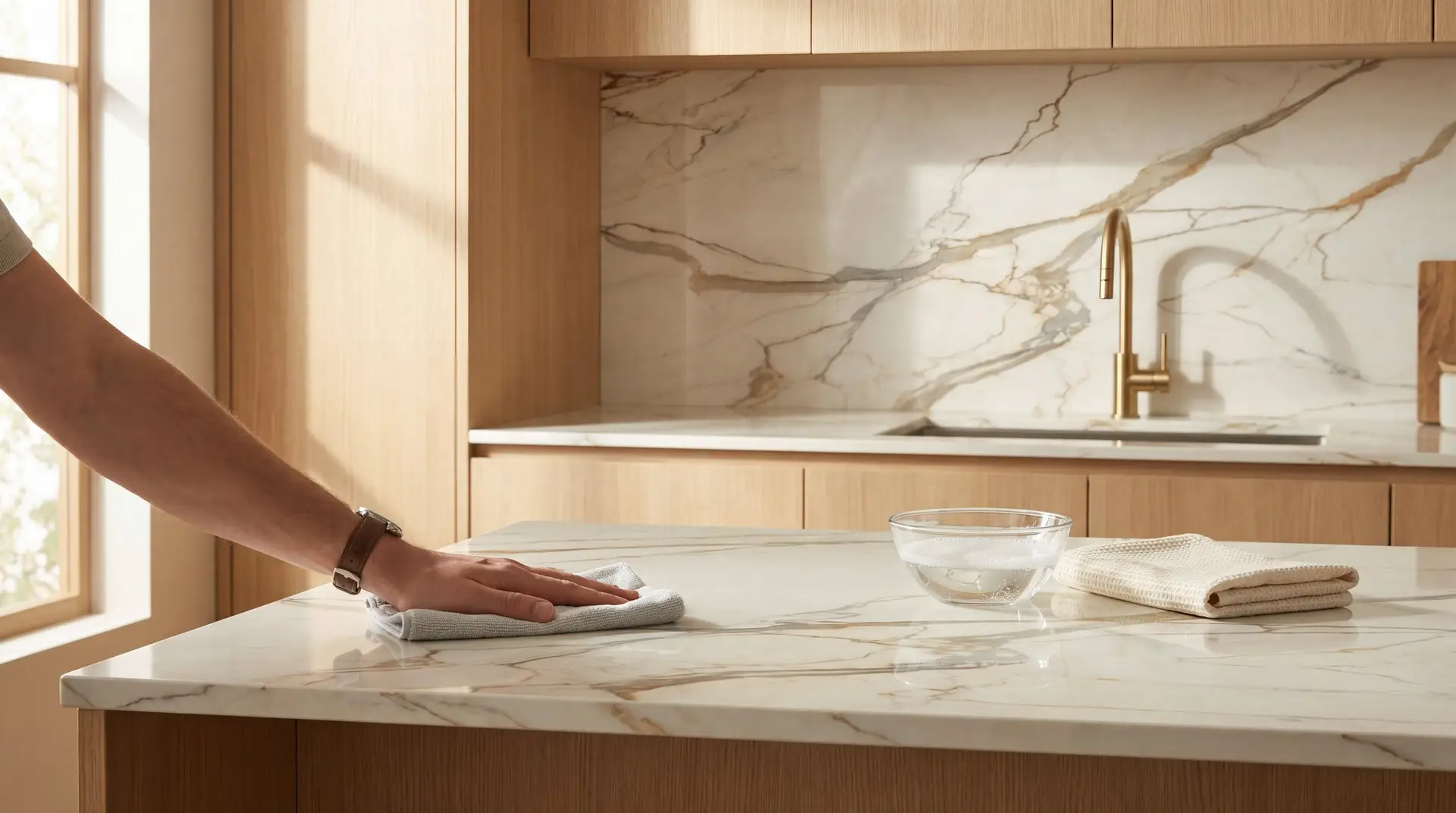
How to clean porcelain countertops: use warm water, a few drops of mild dish soap and a soft cloth or non-abrasive sponge. Wipe away the soap with clean water, then dry the surface with a clean towel. No sealer, no polish.
Most problems come from too much product, the wrong pad, or a cleaner that leaves a film. Pacific Shore Stones distributes porcelain from several manufacturers, including its own Pacshore Tech line, and this routine follows its official stone care guides.
Lynette, from the Pacific Shore Stones Little Rock location, covers the basics in this short video.
How to Clean Porcelain Countertops Daily
- Clear crumbs and dust. A dry microfiber cloth lifts grit before you add water.
- Wash with warm, soapy water. Add a few drops of mild dish soap to warm water and use a soft cloth or non-abrasive sponge. Keep a dedicated cloth, since a dishcloth can transfer oils to the surface.
- Wipe off the soap. Go over the area with a cloth dampened in clean water. Streaks usually mean the soap was not diluted enough.
- Dry it. A clean towel prevents water spots and cloudy mineral residue.
- Clean spills right away. Porcelain absorbs almost nothing, but the faster you clean a spill, the easier it comes off.
What is the best cleaner for porcelain countertops?
Warm water with a few drops of mild dish soap handles daily cleaning. For a deeper clean, use a pH-neutral cleaner made for porcelain or tile.
Leave waxes, oil soaps and “shine” products out of the routine. Neolith warns that detergents with waxes or polishing additives leave an oily film after several washes.
Dried-on food
The Pacific Shore Stones Care & Maintenance Guide gives the method: apply warm water, wait a few minutes, then lift the residue gently with a plastic scraper. Skip metal blades and force.
Cleaning by Finish
Porcelain slabs come in several finishes. Pacshore Tech, for example, is offered in matte or polished versions.
Not sure which you have? Look at it under a light: polished is highly reflective, matte is not.
| Finish | What to know | How to adjust |
|---|---|---|
| Polished | Polishing opens surface microporosity, so polished slabs stain a little more easily and scratch under abrasive tools (LX Hausys). | Non-abrasive tools only, no cream cleansers |
| Matte, satin, silk or honed | Shows metal marks, fingerprints and daily use more than polished (Caesarstone). | Neutral detergent; rinse and dry every time |
| Textured | Dirt settles into the texture instead of sitting on top. | Soft brush first, then the usual wash and dry |
Why matte porcelain looks dirty after cleaning
Matte porcelain can look water-spotted even right after cleaning. Three things usually cause that look, and none of them is damage:
- Cleaner film. Soap residue and filming products make clean porcelain look dull or streaky.
- Limescale. Minerals from tap water dry on the surface, and they show more on dark colors.
- Metal marks. Gray streaks from pans, rings and utensils, which matte finishes pick up most.
Reset the surface with a neutral cleaner, a clean-water rinse and a dry towel. Then treat what remains with the steps below. Do not buff with mineral oil or apply a sealer: both leave one more film.
How to Clean Porcelain Countertops When Soap Fails
Before you use anything stronger, the care guide asks you to confirm the product suits the installed surface and to follow the manufacturer’s instructions. Test it on a small, hidden area first.
Stubborn marks
In the Pacific Shore Stones video, the next step up from a soapy cloth is a sponge with a gentle stain remover, or a melamine foam sponge. Use melamine foam only as a gentle spot step: keep it wet, use light pressure and work only on the mark.
Metal and pencil marks
Gray lines from pots and aluminum cookware sit on top of the surface. Start with the soapy cloth, then the gentle melamine step above, and rinse and dry.
If a mark stays, follow your slab manufacturer’s care instructions or ask a stone care specialist.
Limescale and hard-water spots
Prevention beats removal: rinse off cleaning residue and dry the surface every time. For existing spots, wash with a pH-neutral cleaner, wipe with clean water and dry with a towel.
For dried buildup, apply warm water, wait a few minutes and lift it gently with a plastic scraper. Keep acidic products off the slab, as the care guide says.
Stains
Porcelain resists most kitchen stains. Permanent inks and dyes are the exception, so rinse them off immediately. For residue that survives the daily wash:
- Repeat with warm water, a few drops of mild dish soap and a soft cloth.
- Move to a pH-neutral cleaner made for porcelain.
- For anything still stuck, follow your slab manufacturer’s care instructions.
- If it stays, call a stone care specialist.
The care guide lists strong solvents, acetone and paint removers among the products to avoid on premium surfaces.
What Not to Use
Is vinegar safe on porcelain?
No. The Pacific Shore Stones guide says to avoid vinegar and other acidic products, and the video warns that acids and ammonia can damage the glazed surface. For limescale, use the pH-neutral method above.
Is baking soda OK on porcelain?
Dissolved, yes. Atlas Plan suggests a tablespoon dissolved in plenty of warm water.
Skip it as a paste. A paste acts as an abrasive, the care guide says to avoid abrasive products, and Neolith rules out abrasive cleaners on its Polished finish.
Bleach and ammonia
The guide lists bleach and ammonia among the products to avoid, and the video warns against ammonia and harsh chemicals. If you need to disinfect, choose a product your slab’s manufacturer approves and rinse with clean water.
Never use
- Rust removers with hydrofluoric acid. Neolith, Atlas Plan and Caesarstone all rule it out.
- Vinegar, descalers, hydrochloric acid or caustic soda.
- Bleach, ammonia, glass cleaners and strong degreasers.
- Steel wool, metal blades, abrasive sponges or scouring pads, which can dull the finish.
- Oven cleaners, paint removers, acetone and strong solvents.
- Waxes, oil soaps, impregnating agents or a polishing machine.
Protecting the Slab
Hot pans
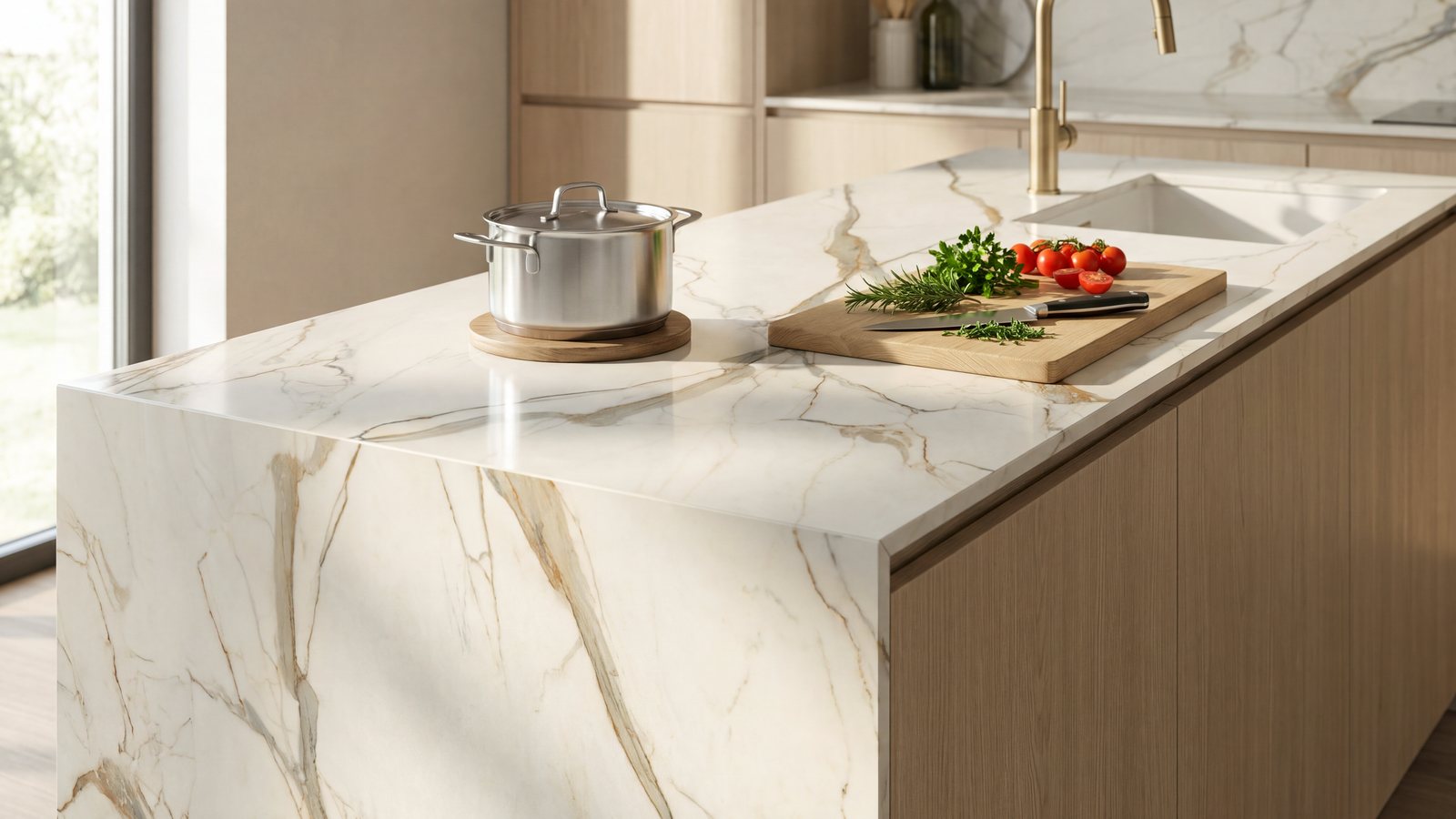
Porcelain is fired at very high temperatures, so it handles heat well. Still, the Pacific Shore Stones care guide says not to place hot items directly on the surface.
Use trivets as a habit. Set appliances that stay hot for long periods on an insulated mat.
Knives and heavy cookware
Use a cutting board. Ceramic-blade knives can scratch porcelain, because the two materials have similar hardness. Lift pans and small appliances instead of dragging them.
Edges, corners and sink cutouts
The flat surface is tough; the edges are the weak point. The care guide lists edges, corners, sink cutouts and mitered areas as the spots to protect from strong impact. It also warns against heavy pressure on unsupported areas.
Set heavy pots down away from the edge. If a chip happens, call your fabricator. Neolith’s epoxy repair method is not a perfect match, since tone and texture are very hard to blend.
Porcelain Does Not Need a Sealer
The care guide says premium surfaces usually do not require sealing, and the video says porcelain never has to be sealed. Neolith calls impregnating agents unnecessary and warns they can leave an oily layer. On a non-porous slab, a sealer has nothing to soak into and stays on top as one more film.
Sintered stone, such as Neolith, is a more compacted relative of porcelain. It cleans the same way, so if you are wondering how to clean Neolith countertops, follow the routine above. Our guides to what sintered stone is and how the porcelain slab brands compare explain the difference.