
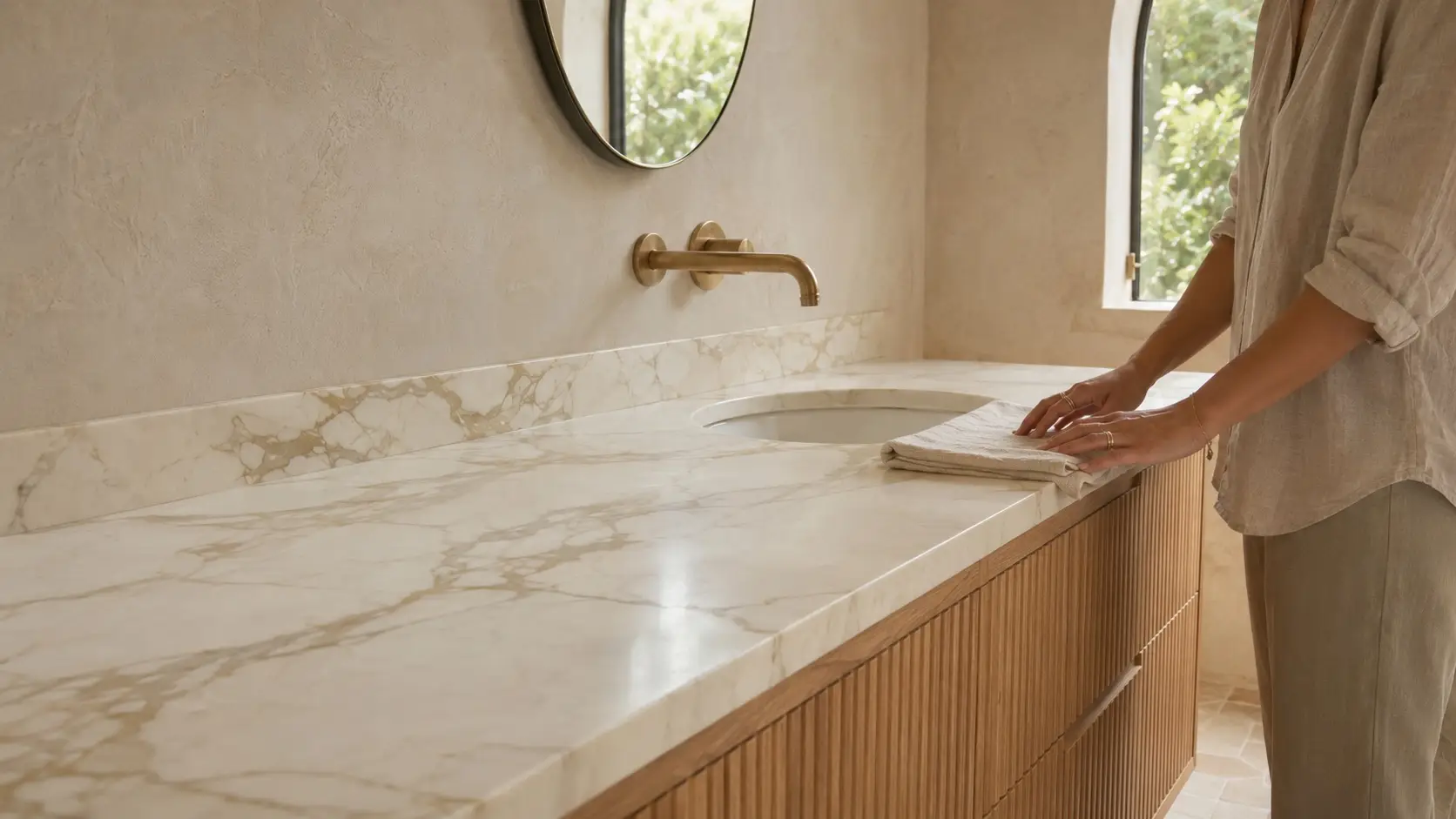
Calacatta Gold works almost anywhere in a bathroom: vanity tops, shower walls, floors, and full-height feature walls, all carried by its bright white background and warm gold veining.
The one decision that shapes every idea below is whether you use natural Calacatta Gold marble or an engineered look-alike built for wet, high-use spaces. This guide covers both, with ideas by zone, drawing on the marble and engineered slabs Pacific Shore Stones distributes across 17 showrooms.
What Calacatta Gold Actually Is
Calacatta Gold is a natural marble, a metamorphic stone made of calcite, or calcium carbonate, quarried in the mountains around Carrara, in Italy’s Apuan Alps. Its signature is a bright, near-white background crossed by warm gold and gray veining. Within the Carrara family, the Calacatta grades are the rarer, more exotic variations, which is part of why they command a premium.
Because it’s calcite, Calacatta Gold is soft, just 3 on the Mohs scale, and chemically reactive: acidic liquids like citrus, wine, or many cleaners dissolve a trace of the surface and leave a dull etch mark. None of that rules it out for a bathroom; it just shapes where and how you use it. It also separates marble from quartzite, two natural stones often confused and worth keeping straight when you specify.
Natural Marble or an Engineered Look-Alike?
This is the decision that drives every idea below. Natural Calacatta Gold marble gives you a one-of-a-kind slab, with no two runs of veining alike, but it needs sealing and acid-aware care. In a low-splash zone like a vanity backsplash or a feature wall, that’s easy to live with. In a shower or on a floor that sees constant water and cleaning products, many homeowners prefer a non-porous alternative.
The Calacatta Gold look is widely reproduced in engineered surfaces. Silestone’s Eternal Calacatta Gold is one such version, and it’s non-porous, so it doesn’t absorb liquids and needs no sealing.
Porcelain and sintered-stone versions, like Atlas Plan Calacatta Gold and Neolith Calacatta Gold, are also effectively impervious, with water absorption at or below 0.5% under the standard porcelain definition.
Calacatta Gold Bathroom Ideas
-
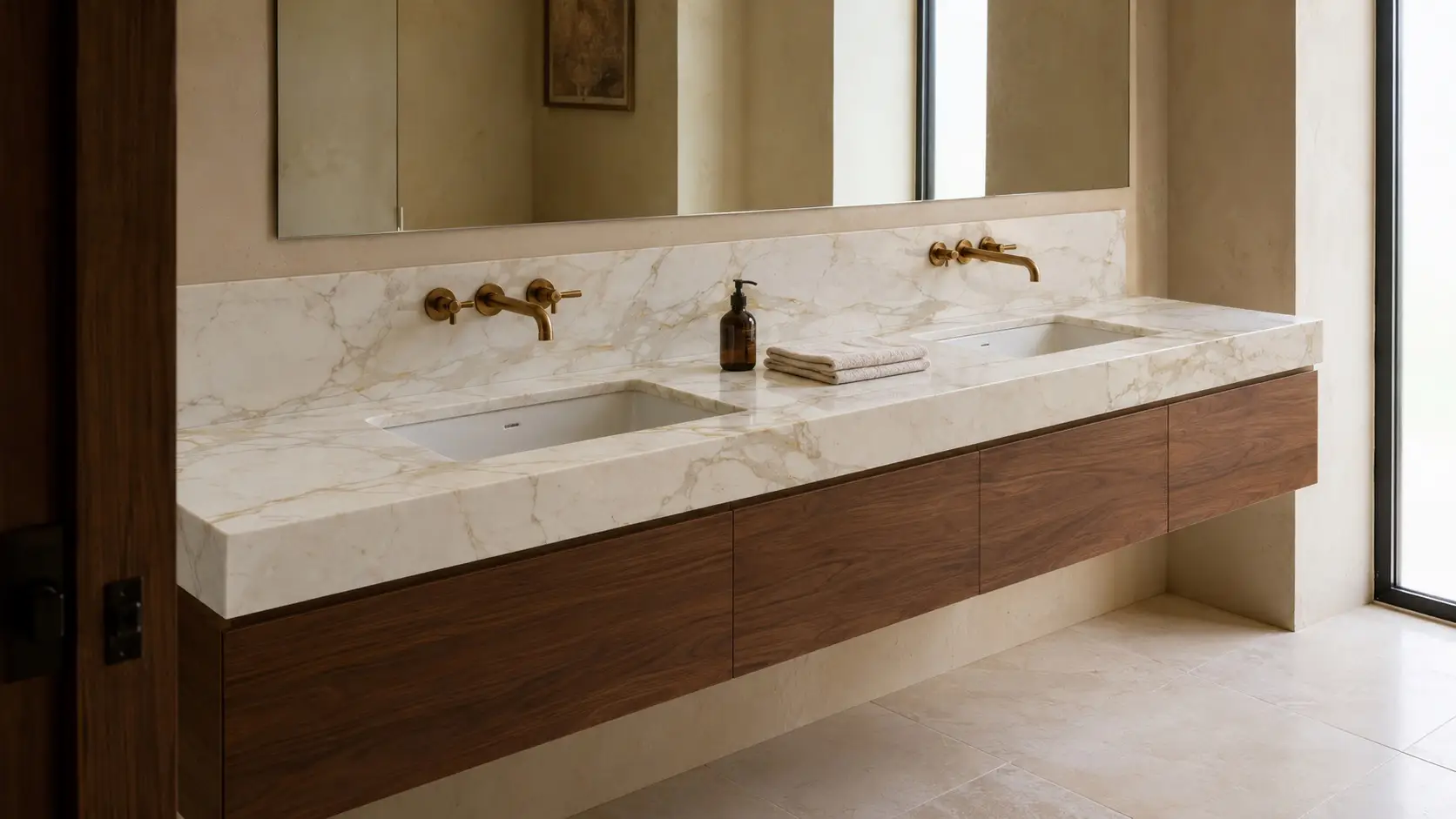
Vanity top. The classic use. A single Calacatta Gold slab across a double vanity makes the veining the room’s centerpiece. In natural marble, seal it and keep acidic products off the surface; if the vanity sees heavy makeup and cleaning products, the engineered version holds up with less fuss.
-
Shower walls and surround. Full-height slabs, especially bookmatched, where two mirrored pieces open like a butterfly, turn a shower wall into a feature. For a constant-water zone, porcelain or sintered Calacatta Gold is the low-maintenance route; natural marble works too but wants a squeegee after each use to limit buildup.
-
Feature or accent wall. Behind a freestanding tub or spanning a single wall, a bookmatched Calacatta Gold panel reads as art. Drier zones like this are where natural marble is easiest to enjoy.
-
Niches and accents. Shower niches, curbs, and thresholds are a smart place to use offcuts from a slab, tying the small details back to the main surface.
Caring for Calacatta Gold in a Bathroom
If you go with natural marble, two rules cover most of it. First, clean only with a neutral, non-acidic cleaner, never vinegar or citrus-based products. Second, understand what sealing does: it makes the stone more resistant to staining, but it does not make it stain-proof, and it doesn’t prevent etching, which is a chemical reaction rather than a stain. A squeegee after showers keeps water spots and soap scum down.
Engineered versions skip most of this, since non-porous surfaces don’t need sealing and shrug off acidic products.
See Calacatta Gold in Person
Calacatta Gold is all about the veining, and no two slabs match, which is exactly why a photo can’t stand in for seeing one. Pacific Shore Stones distributes natural Calacatta Gold marble alongside engineered and porcelain versions of the look across 17 showrooms in California, Texas, Oklahoma, Arkansas, Nevada, and Mississippi.
Browse the marble collection, check live inventory, or compare finishes on a full slab in person.