
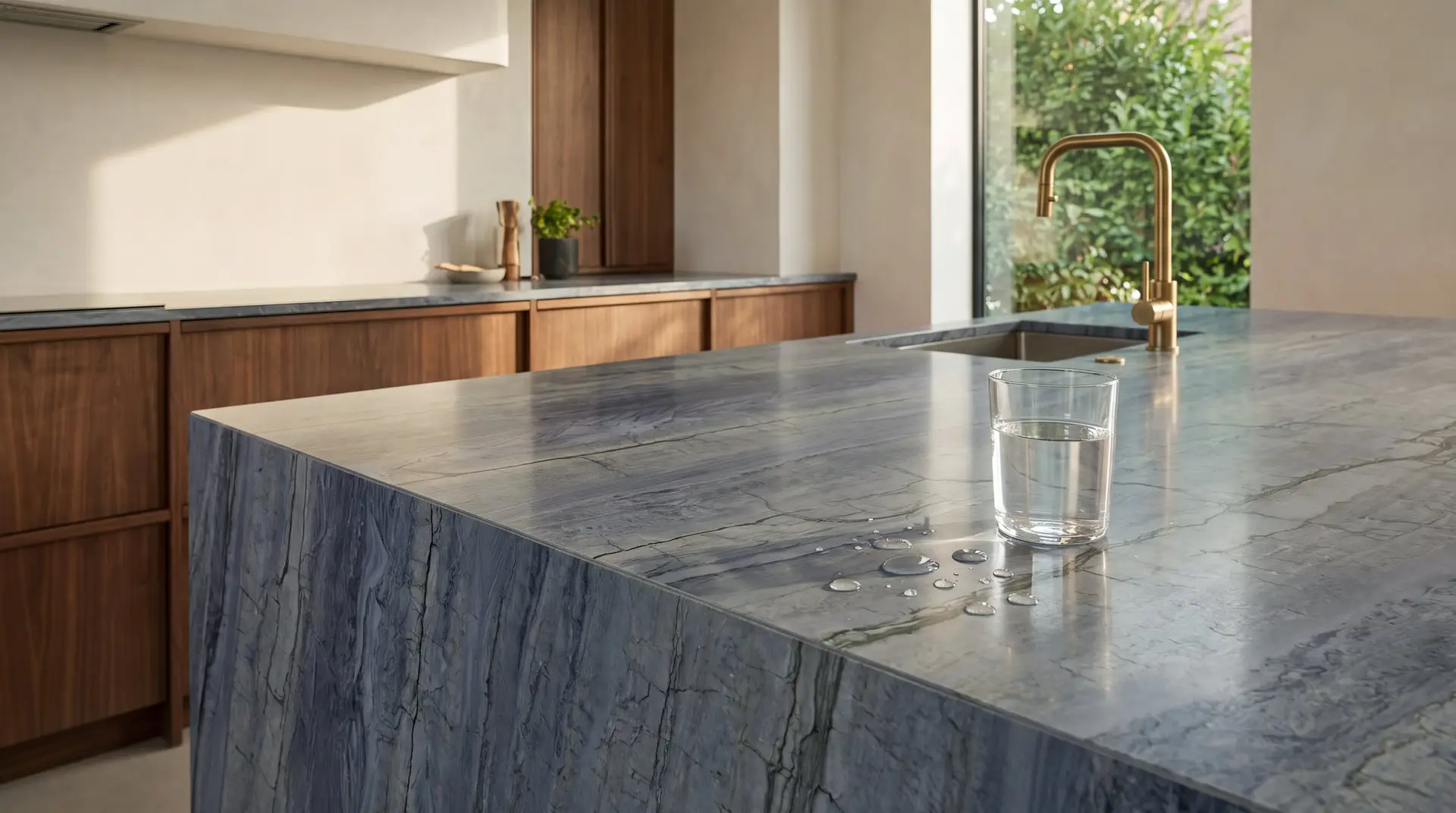
Does quartzite need to be sealed? Usually yes, but it depends on the slab. The Pacific Shore Stones Quartzite Care Guide says to seal quartzite after installation and reseal it as needed.
A 15-minute water test decides what “as needed” means. Sealing reduces absorption, but it does not make the stone stain-proof, heat-proof, scratch-proof or acid-proof.
Which Quartzite Needs to Be Sealed
Quartzite starts as sandstone fused by heat and pressure. The Natural Stone Institute’s deep dive on quartzite explains that stones sold as quartzite range from grainy and fairly porous to fully crystalline and dense.
In its soak test, a White Macaubas sample wicked water above the waterline. A Taj Mahal sample barely looked wet. Both rate 7 on the Mohs scale, so hardness does not tell you porosity.
Does Taj Mahal Quartzite Need to Be Sealed?
Less often than most, but its edges still do. Taj Mahal is one of the denser quartzites, as the soak test above shows. Its top may rarely take sealer, so let the water test decide for your own slab.
Cristallo follows the same rule: seal after installation and use the 15-minute water test. Its care guide adds that it can be fragile around edges, corners, seams and cutouts.
Soft Quartzite and Dolomite
Some stones sold as quartzite are softer, calcite-bearing stones. The Pacific Shore Stones primer, 5 things you need to know about quartzite, lists Grey Goose/Super White and Fantasy Brown as “soft” quartzites.
Ask the showroom or your fabricator what the stone is. If dull marks appear where acidic spills sat, the stone etches like marble, and the Dolomite Care Guide applies. Sealing still slows stains on a soft slab, but it cannot prevent etching.
Honed and Leathered Finishes
Polishing closes much of the surface. Honing and leathering leave it more open, so a honed slab absorbs more sealer and needs resealing sooner than the same stone polished. Our guide to Taj Mahal quartzite finishes reaches the same conclusion.
Edges and Sink Cutouts
These are the weak spots. Many slabs are resin-treated at the factory to fill surface pits and fissures. Cutting sink holes and edge profiles exposes raw stone the resin never reached.
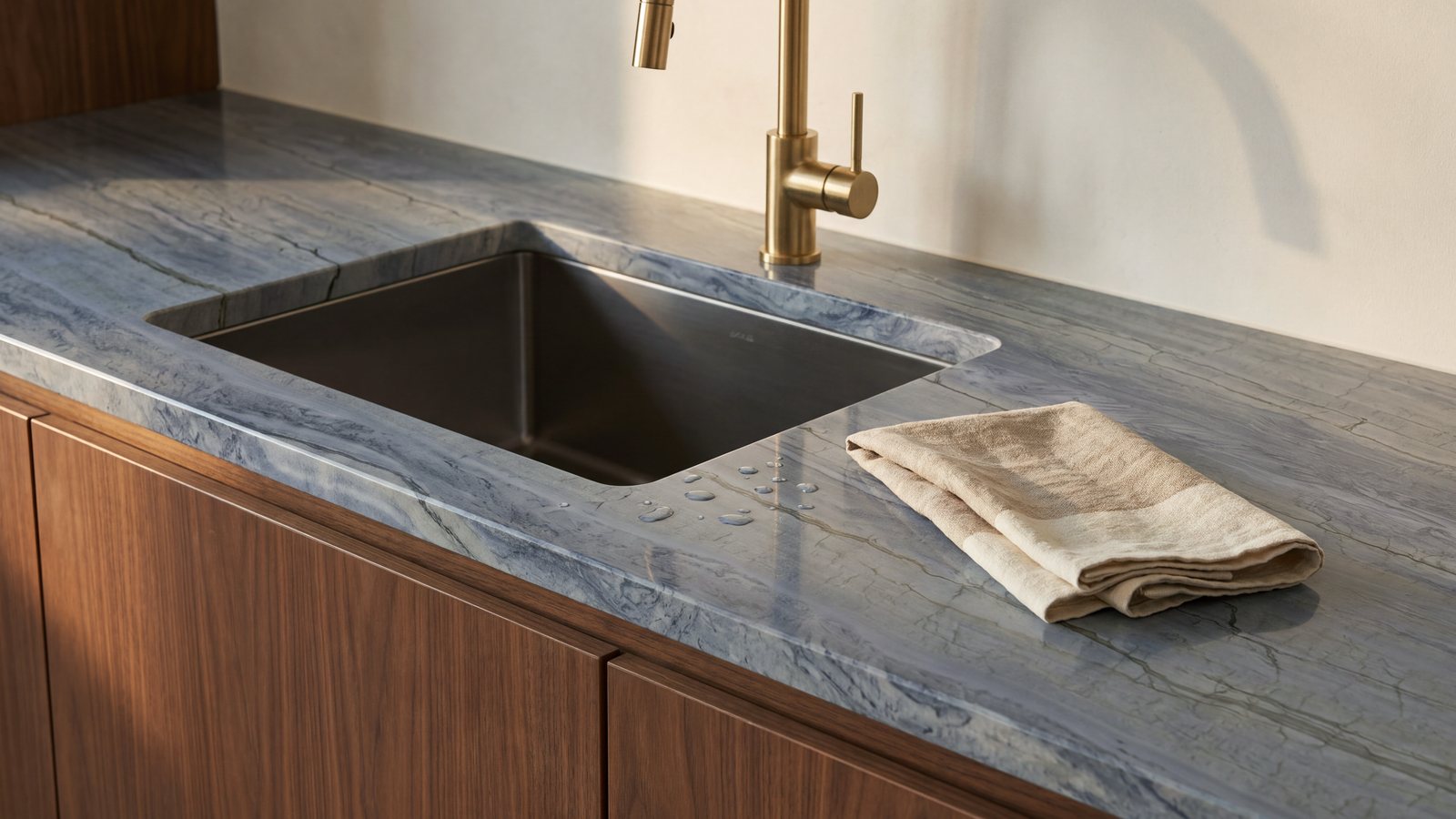
The Natural Stone Institute’s advice is to seal all worked edges, not just the top.
Engineered surfaces are different: they are made to be nonporous and never need sealing. Our comparison of engineered surfaces and quartzite covers that maintenance gap.
The 15-Minute Water Test
To answer “does quartzite need to be sealed” for your own kitchen, use the check in the Pacific Shore Stones care guides. Leave water on the surface for about 15 minutes. If the stone darkens, it may be time to reseal.
- Clean the spot with a few drops of mild dish soap in warm water, rinse and let it dry completely.
- Pour small puddles next to the sink, near the cooktop, on the island and on an edge.
- Wait about 15 minutes, wipe the water away and look at the stone at eye level.
- Darkened stone is absorbing. Beaded water and unchanged stone mean the sealer, or the stone’s density, is working.
In a kitchen, also test a few drops of cooking oil in a hidden spot. Oil can find pores that water beads over.
What Happens If You Don’t Seal Quartzite?
Nothing structural. The damage is cosmetic and often permanent: oil, wine and coffee soak in and leave dark patches. On a dense slab that passes the test, skipping the sealer changes little.
How to Seal Quartzite Countertops
Sealing is a manageable DIY job. It depends on two things: a dry stone and a clean wipe-off.
Best Sealer for Quartzite
Use an impregnating sealer, not a topical coating. The Natural Stone Institute explains that stone sealers are impregnators: they soak in and repel liquids instead of forming a film. Topical coatings can peel, trap moisture and change the look of the stone.
- Oil and water repellency. The label should promise protection against both.
- Food safety. The Natural Stone Institute asks that sealers in food prep areas be non-toxic and safe for that use.
- Clear, not enhancing. Color-enhancing sealers darken stone for good. On white or cream quartzite, buy a clear impregnator.
- Resin compatibility. Some sealers are not meant for resin-treated stone, so check the label.
Sealing Step by Step
Follow your sealer’s label for every time and amount below.
- Test first. Run the 15-minute water test. If water beads everywhere, stop, because a stone that cannot absorb sealer will only haze.
- Clean. Clear the counter and wash with a few drops of mild dish soap in warm water. Rinse and dry with a towel.
- Let it dry completely. Trapped moisture is the classic cause of a milky finish. Overnight is the easy rule after a wet deep-clean.
- Spot-test. Open the windows and try the sealer on a hidden area first.
- Apply one section at a time. Spread an even coat with a lint-free cloth or applicator pad.
- Keep it wet for the dwell time. Follow your sealer’s label, typically 10 to 15 minutes. Add sealer to spots that soak it up.
- Wipe off every bit of excess. Use clean, dry towels until the surface feels dry. This step decides whether you get a clean finish or a haze.
- Add a second coat where it is thirsty. Porous slabs, honed tops and cut edges often need one. Follow the label, typically within 30 to 40 minutes of the first.
- Let it cure, then retest. Keep the counter dry for the label’s cure time, then repeat the water test.
How Long to Wait After Sealing
Cure times vary, so follow your sealer’s label. Light use is typically fine after 6 to 24 hours, and a full cure usually takes 24 to 72 hours or longer.
Sealing Mistakes to Avoid
- Sealing a damp stone. The result is cloudiness that is hard to undo.
- Letting excess dry on top. If haze appears, rewet the area with sealer and wipe it dry with clean towels. Skip abrasive pads.
- Panicking at the wet look. Some sealers look dark or milky while wet and dry clear.
- Harsh cleaners afterward. Vinegar, bleach, ammonia, glass cleaners and abrasive powders wear sealer down. See how to clean quartzite for a routine that protects it.
How Often Quartzite Should Be Sealed
There is no fixed schedule. The Pacific Shore Stones guidance is simple: reseal as needed, based on the water test.
| Situation | What to do |
|---|---|
| New install | Water test once the stone has dried out; seal any area that darkens, edges included |
| Busy kitchen, porous or honed slab | Water test near the sink and cooktop every few months |
| Dense polished slab, light use | Water test once or twice a year |
| Stone darkens within 15 minutes | Clean, dry and reseal that area |
The sink zone usually fails first, because water and soap reach it all day. You can reseal just that area once the stone is dry.
Should You Hire a Pro?
Most homeowners can reseal with one bottle of impregnating sealer, clean towels and an afternoon.
A pro makes sense when the slab needs stain removal first or an earlier coat left haze. Pacific Shore Stones distributes slabs and does not seal or install, so call your fabricator or a local stone-care company.
Choosing a Low-Maintenance Quartzite
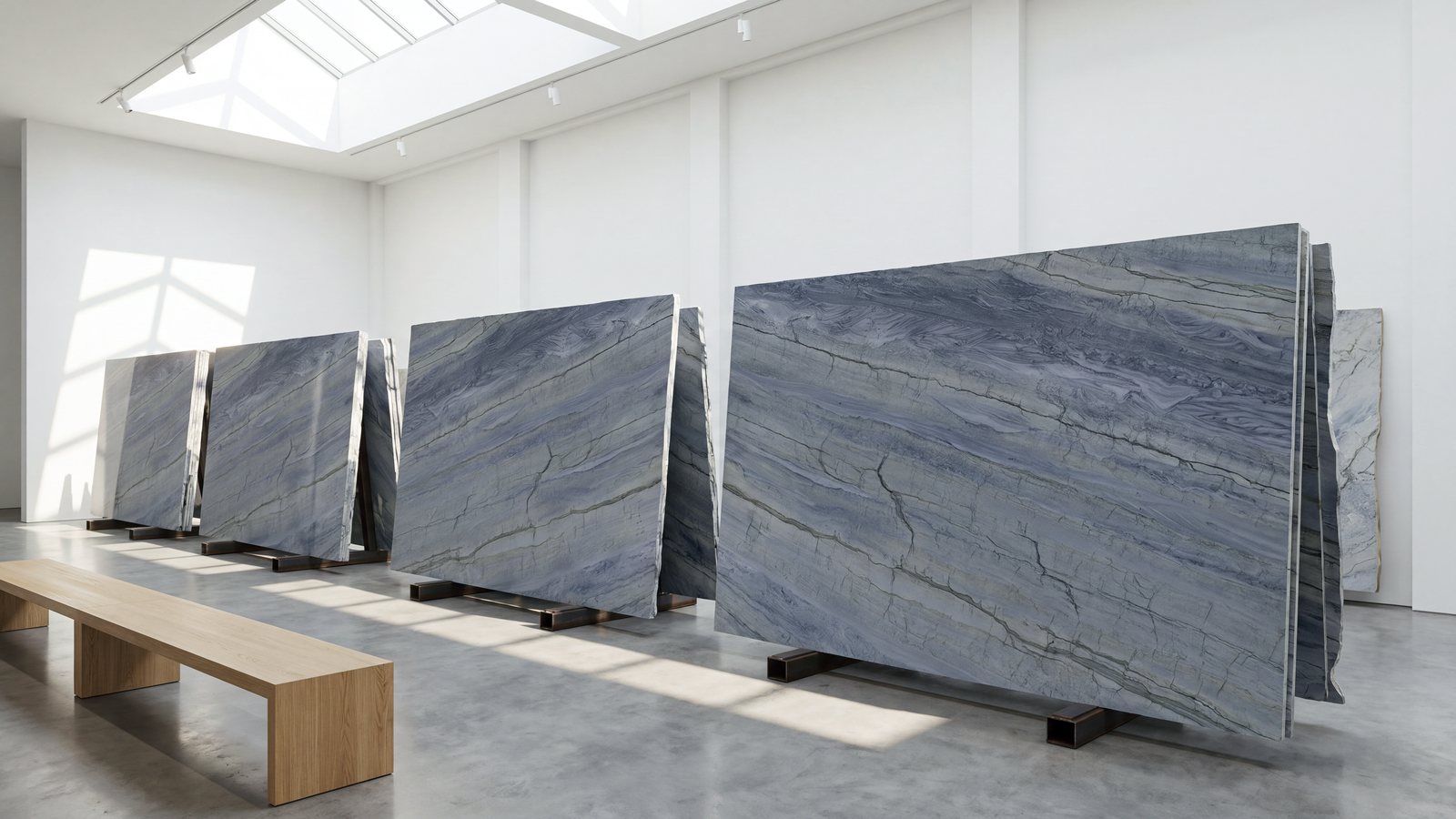
The lowest-maintenance plan is a dense stone in a polished finish. Ask for an offcut of the exact slab and run the water test at home. That answers “does quartzite need to be sealed” before the slab reaches your kitchen.
Pacific Shore Stones has distributed natural stone since 2004. Compare quartzite and Taj Mahal slabs in person at the 16 Pacific Shore Stones showrooms in California, Texas, Oklahoma, Arkansas, Nevada and Mississippi.
Browse the quartzite collection or download the free quartzite guide for applications and buyer questions.