
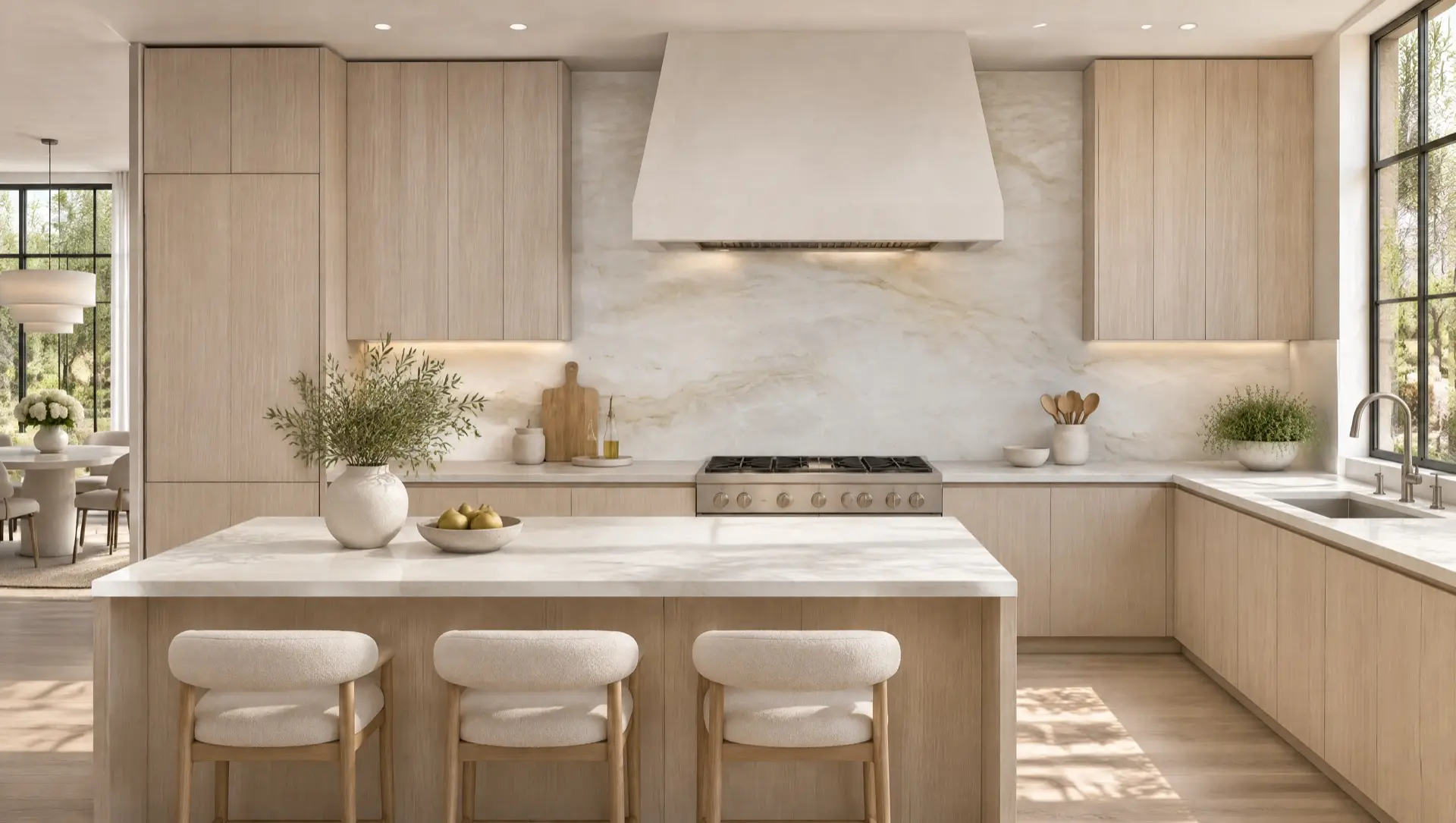
The biggest kitchen trend for 2027, if you are choosing stone, is that designers now favor quartzite over quartz. In the 2027 Kitchen Trends Report from the National Kitchen & Bath Association (NKBA), released October 14, 2026, quartzite led at 78% and quartz followed at 74%. Nearly half of designers (48%) also said they prefer honed or matte finishes.
For last year’s picture, see our 2026 kitchen renovation trends guide.
How Quartzite Overtook Quartz
Who the report surveyed
The report is a forecast from 830 professionals across the U.S. and Canada, 90% of them based in the U.S. Designers made up 62% of respondents. The rest were showroom staff, dealers, remodelers, contractors, manufacturers and architects. Each had designed, specified or sold products for at least one kitchen in the previous 12 months.
That makes it a professional outlook for the next three years rather than a count of finished kitchens.
From second place to first
In the 2026 report, natural quartzite sat right behind quartz, at 62% for countertop materials. A year later, it has moved to the top. The NKBA’s own summary of the 2027 report links the change to how people renovate. As more homeowners stay put and remodel, lasting quality and long-term value are taking priority over short-lived trends. Countertops now rank among the strategic investments, alongside layout, cabinetry and appliances.
Choosing a Quartzite Countertop in 2027
Quartzite is a natural stone, so color, veining and porosity vary from slab to slab. According to the Natural Stone Institute’s guide to quartzite, true quartzite will not etch from everyday kitchen acids such as lemon juice or vinegar. Porosity is less uniform. Taj Mahal is an example of a stone whose minerals are tightly bonded, while more porous varieties benefit from sealing. Because some stones sold as quartzite turn out to be marble, a simple test on a sample is a sensible first step.
Taj Mahal and Perla Venata for a neutral kitchen
Taj Mahal quartzite is the softer of the two, an off-white to pale gray ground with beige and taupe veins and clouds. Perla Venata quartzite is more linear, with gray veins running in long diagonal layers across a light gray-white ground. Our quartzite guide explains how stones like these differ and what to look for in a slab.
Quartz brands for a consistent pattern
Quartz from Caesarstone, Cambria, HanStone and Viatera gives you a consistent pattern from slab to slab, while quartzite gives you a one-of-a-kind piece. Pacific Shore Stones carries both, and our comparison of quartz vs. quartzite countertops sets out the differences.
Honed and Matte Finishes Gain Ground
The 48% preference for honed or matte surfaces changes how a stone looks and how it lives day to day. A guide to selecting a stone finish lays out the options. A polished surface reflects light. A honed surface is smooth, with little or no gloss and a more muted look, so grain and pattern show less strongly, but small imperfections are easier to hide. A leathered surface has a textured feel that resembles leather and resists fingerprints and smudges, although its fissures take a little more effort to clean.
Low-sheen surfaces can also show daily marks more readily. Caesarstone notes that its honed and other textured finishes need more cleaning than polished ones, because metal marks and fingerprints show more. Our guide to polished, honed and leathered finishes compares all three.
Kitchen Color Trends 2027 in Stone
Neutrals remain the top color choice in the 2027 report, at 96%. Greens (83%) and blues (75%) follow, both slightly down from 2026, while reds, including burgundies and bright reds, held steady at 47%. Our showrooms carry slabs in each of these color families.
Where color goes: the backsplash and the island
The 2026 report already pointed to the surfaces where that color tends to land. It expected new statement colors on the backsplash (60%) and the island (57%), and named slab or solid-surface backsplashes as gaining popularity (75%), with quartzite at 61% for backsplashes. A full slab in a showroom shows how veining runs across a surface that large far better than a small sample can.
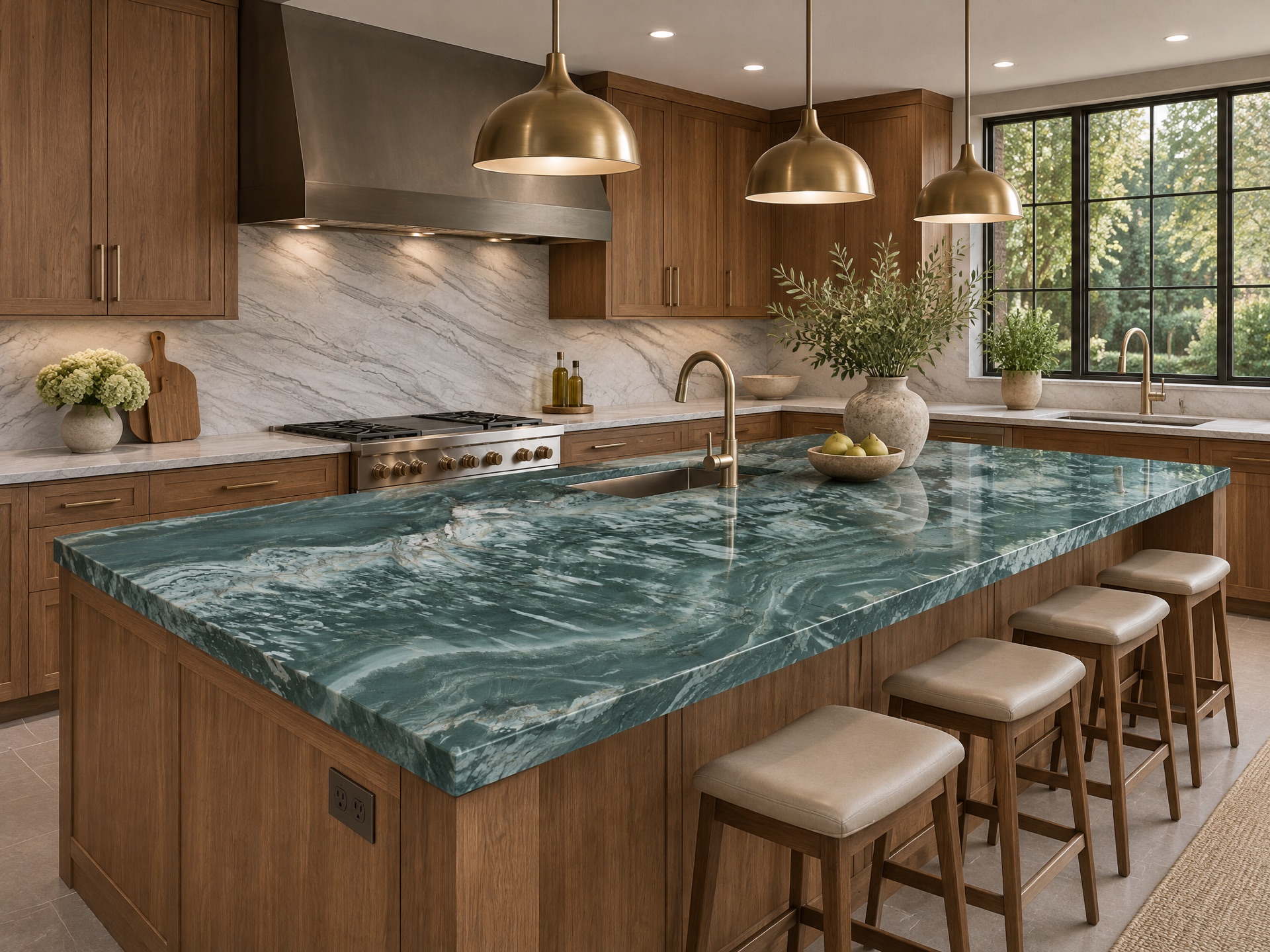
Green quartzites
Persa Green quartzite is the deeper of our two greens, a teal-green ground with lighter, wavy veining. In its leathered version the color softens to sage-teal, layered with dense white waves. Emerald Green quartzite changes from lot to lot. One lot shows a soft jade-to-sage green with a crackled crystalline texture and fine white and golden veins, while another is paler, closer to sage green and gray.
Blue quartzites
Ijen Blue is the most understated of the blues, a soft steel blue-gray traced with fine charcoal and golden hairline veins. Azul Macaubas goes the other way. The Natural Stone Institute names it as an example of vividly colored quartzite, and its periwinkle ground carries fine parallel lines of deeper blue. Tempest Blue brings contrast, with wide cream to pale peach bands crossing a charcoal and slate blue-gray.
Calacatta Viola for burgundy
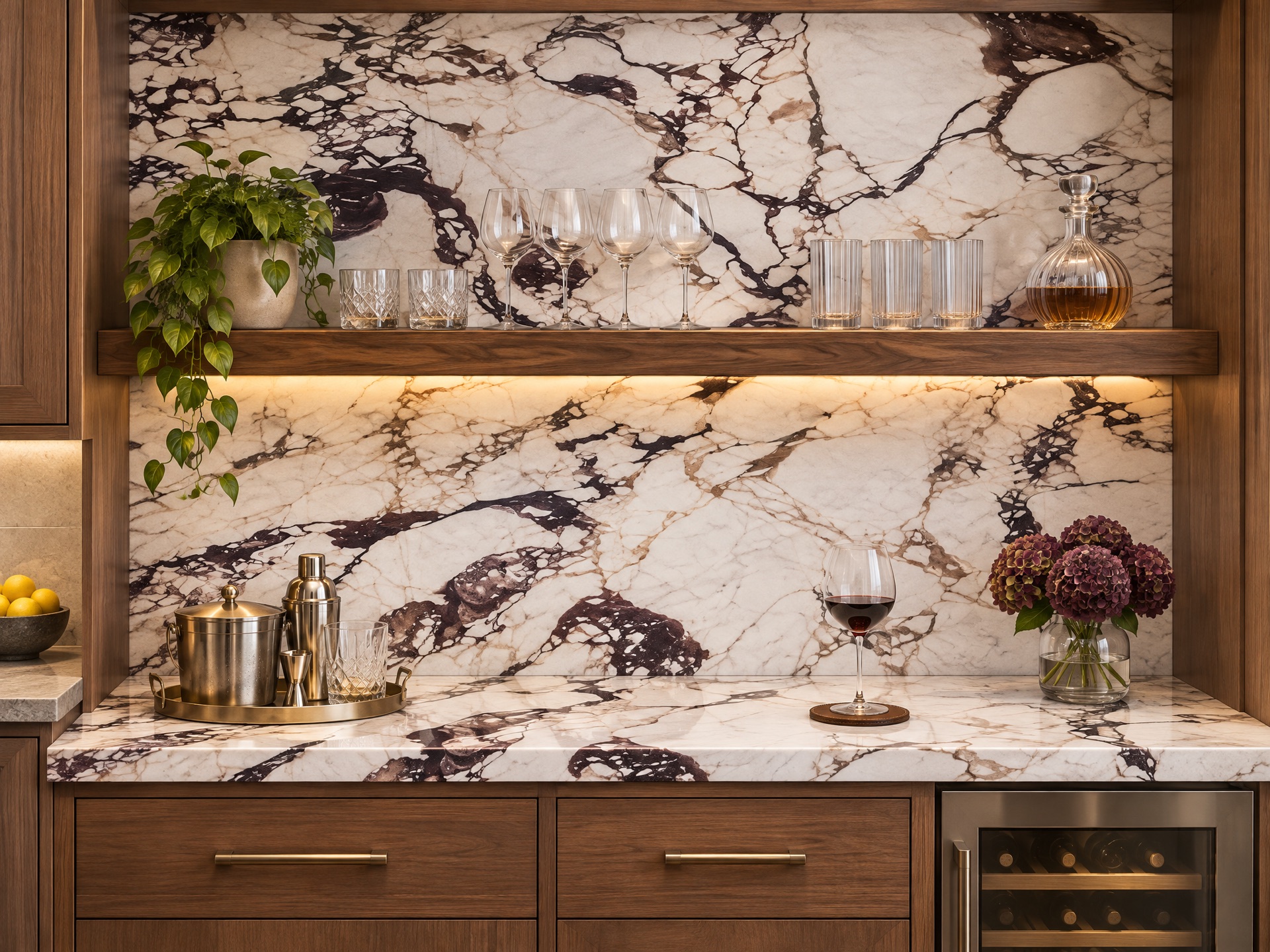
For the reds that held steady, Calacatta Viola marble outlines white fragments with deep burgundy-brown to plum veins. As a marble, it can etch from acids such as wine and citrus, so coasters under glasses are a good habit, as the stone care guidelines recommend.
The stones by color family
| Stone | Type | Color family |
|---|---|---|
| Taj Mahal | Quartzite | Neutral |
| Perla Venata | Quartzite | Neutral |
| Persa Green | Quartzite | Green |
| Emerald Green | Quartzite | Green |
| Ijen Blue | Quartzite | Blue |
| Azul Macaubas | Quartzite | Blue |
| Tempest Blue | Quartzite | Blue |
| Calacatta Viola | Marble | Burgundy |
See the Slabs Before You Decide
Before you commit, leave a little lemon juice or vinegar on a sample to see whether the stone etches. Our stone care guides cover the daily routine for each material.
We carry quartzite, marble, soapstone and granite alongside Caesarstone, Cambria, HanStone and Viatera. Browse our natural stone collection to narrow the field, then visit one of our showrooms to see full slabs.