
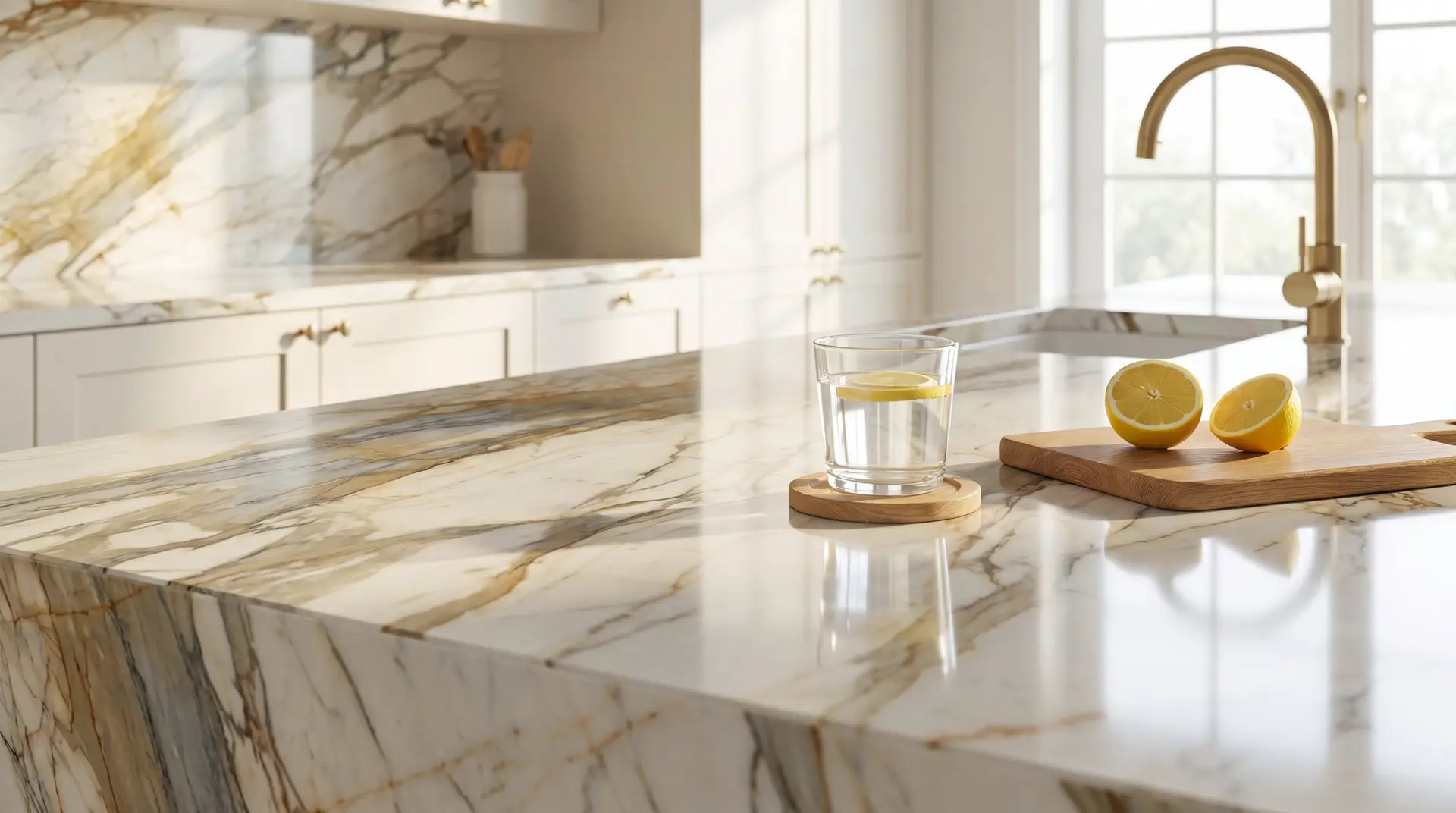
Marble etching is a dull, lighter mark left where acid dissolved a thin layer of the stone’s surface. It is damage, not a stain, so no cleaner will lift it.
The repair is a job for a stone restoration professional, who hones and polishes the etched area. The Pacific Shore Stones Marble Care Guide puts it plainly: etching is a dull mark caused by acids and may require professional polishing.
Many owners also choose to let light marks blend into the stone’s patina.
What Is Marble Etching?
Marble is made mostly of calcite, a form of calcium carbonate, and calcium carbonate reacts with acid. When lemon juice or vinegar touches the surface, the acid eats away a microscopic layer of the polished crystals. The spot then scatters light instead of reflecting it.
Nothing was added to the stone; something was taken away, which is why no cleaner can remove it.
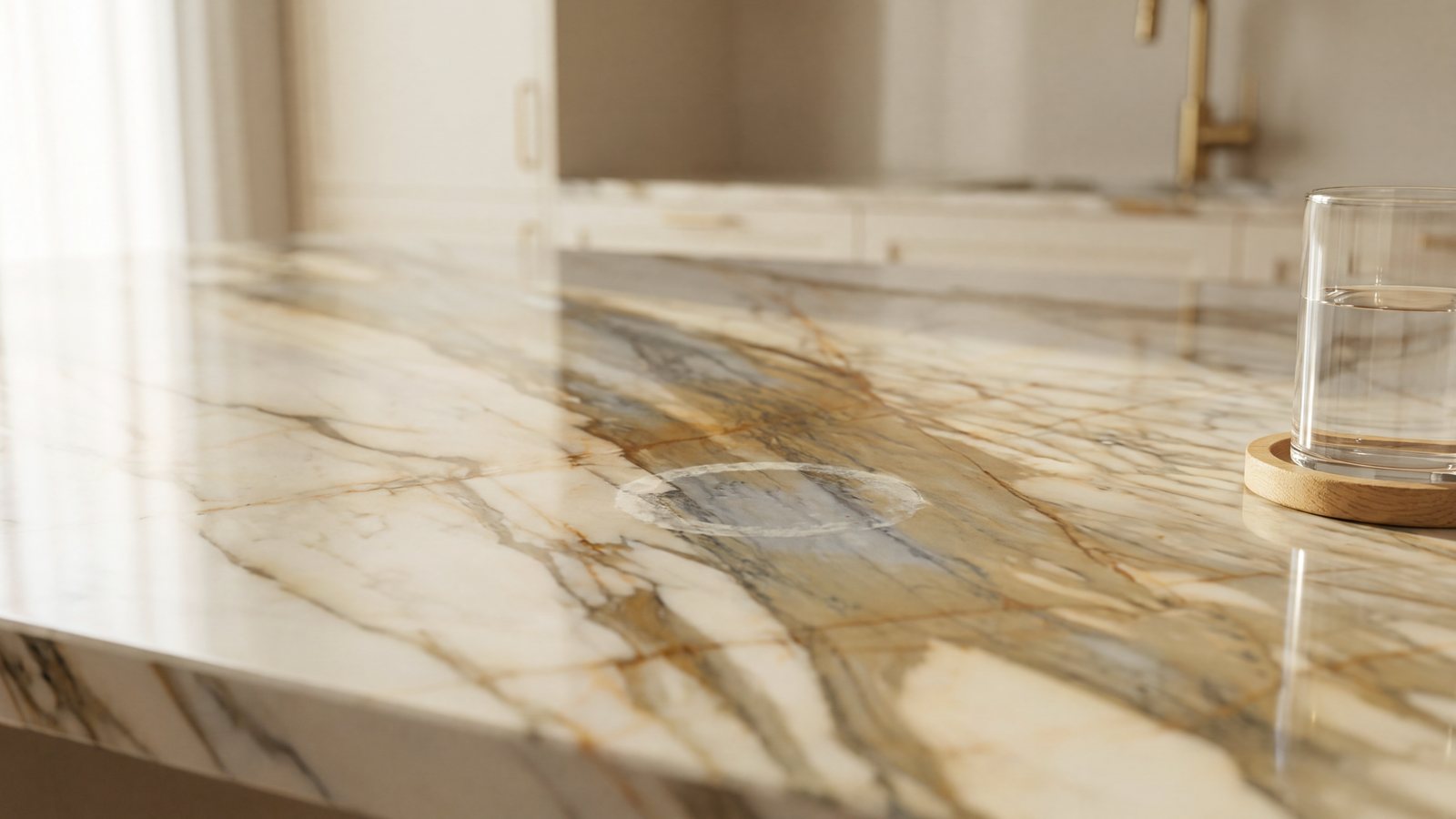
On a polished slab, an etch looks like a dull, cloudy or whitish spot, often in the exact shape of the glass or drip that caused it. On a honed slab it shows as a subtle change in texture, usually visible only when light hits it from the side.
What causes etching
- Citrus juice, vinegar, salad dressing and tomato sauce
- Wine, coffee, soda and fruit juice
- Acidic cleaners, including many bathroom, tile and vinegar-based “natural” sprays
- Makeup and perfume on a vanity (the Marble Care Guide lists both)
Strong alkaline products can leave a similar pale mark, called a caustic mark. It looks like an etch, but the cause is a strong base rather than an acid.
Does sealing prevent etching?
No. Stone sealers are impregnators that, as the Natural Stone Institute notes, act more as a repellent than a true seal. They slow absorption.
Etching is a reaction at the surface, so a freshly sealed counter etches as readily as an unsealed one. The Pacific Shore Stones care guide agrees: sealing reduces absorption but does not make marble acid-proof. Keep sealing for stain protection.
To check it, leave water on the surface for about 15 minutes; if the stone darkens, it may be time to reseal.
Etch, Stain or Water Ring?
Each problem needs a different response, so confirm what you have first.
| Check | Etch | Stain | Hard-water deposit |
|---|---|---|---|
| Color compared with the stone | Lighter, dull or cloudy | Darker | Whitish film or ring |
| Feel with a fingertip | Smooth if light, rough if deeper | Same as the surrounding stone | Like residue on the surface |
| Best view | Low, raking light from the side | Visible from any angle | Visible from most angles |
| Safe first step | None at home; call a pro | Blot, then wash with mild dish soap and water | Wipe with a pH-neutral stone cleaner; if it stays, treat it as an etch |
The quickest rule: a true stain is always darker than the stone around it. A lighter mark is surface damage, and most marks that look like water rings on marble are etches.
For a darker mark, blot it, wash the area with warm water and a few drops of mild dish soap, and dry it. If it stays, call a stone restoration professional rather than trying home chemical treatments, which can lighten, etch or spread a stain.
Our guide on how to clean marble covers daily care. Red wine can leave both a stain and an etch, and a professional can assess both.
How to Remove Etching From Marble
Marble etching cannot be cleaned away. As the Marble Care Guide says, it may require professional polishing. How much work that takes depends on how deep the etch is and whether the marble is polished or honed.
| Severity | What you see and feel | Polished marble | Honed marble |
|---|---|---|---|
| Light | Faint dull ring, smooth to the touch | Pro polishing, or let it blend into the patina | Usually best left to blend in, or a pro |
| Moderate | Clearly visible from normal distance, slight texture | Pro honing and polishing | Pro honing |
| Deep or widespread | Rough to the touch, or many overlapping marks | Pro honing and re-polishing | Pro honing |
What a professional does
A stone restoration professional first checks how deep the etch is and how the marble is finished. They then hone the etched area until the damaged layer is gone, polish it back to match the surrounding finish, and reseal it.
A spot repair can leave a patch shinier than the rest, so ask whether they will treat the spot or the whole surface.
Honed marble
Honed marble has no gloss to restore, so any repair has to match a matte finish. Green scouring pads and powdered cleansers, often suggested online, strip the sealer and can leave a duller circle.
The Pacific Shore Stones care guide lists abrasive powders and rough sponges among the things to avoid. Leave honed repairs to a professional, or let light marks blend in.
What does not work
- Baking soda. It is alkaline and mildly abrasive, and it has no way to restore polish to etched stone.
- Vinegar or lemon. Acid caused the etch. More acid widens it.
- A poultice. Poultices draw out stains. An etch has nothing to draw out.
- Sealer or wax. Neither removes the damage; at most it masks the dullness for a while.
- Home etch remover products. We do not recommend them. Used on the wrong finish, they can leave a patch shinier or duller than the rest of the stone.
Where Marble Etching Shows Most
Polished vs. honed
On polished marble, an etch is a dull spot against a mirror finish. On honed marble, the surface starts matte, so an etch shows only as a faint change in texture. Our post on polished, honed and leathered finishes notes the trade-off: honed hides flaws better but needs resealing more often than polished.
Does dark marble show etching more?
The chemistry is the same on every calcite marble; contrast is what changes. A pale, dull mark stands out on a dark polished marble such as Nero Marquina. On white Carrara or Calacatta it mostly shows as a loss of shine in raking light.
Any repair on black or deep green marble has to match a high-contrast polish, so leave it to a restoration professional.
How to Prevent Marble Etching
The Marble Care Guide recommends:
- Coasters, trays, cutting boards and trivets on every working surface
- Blotting spills right away with a clean cloth, especially wine, coffee, citrus, tomato sauce, vinegar, alcohol, makeup and perfume
- Daily cleaning with warm water, a few drops of mild dish soap and a soft microfiber cloth, then drying with a clean towel
- A pH-neutral stone cleaner for deeper cleaning, and no vinegar, lemon, bleach, ammonia, glass cleaners, bathroom cleaners or abrasive powders
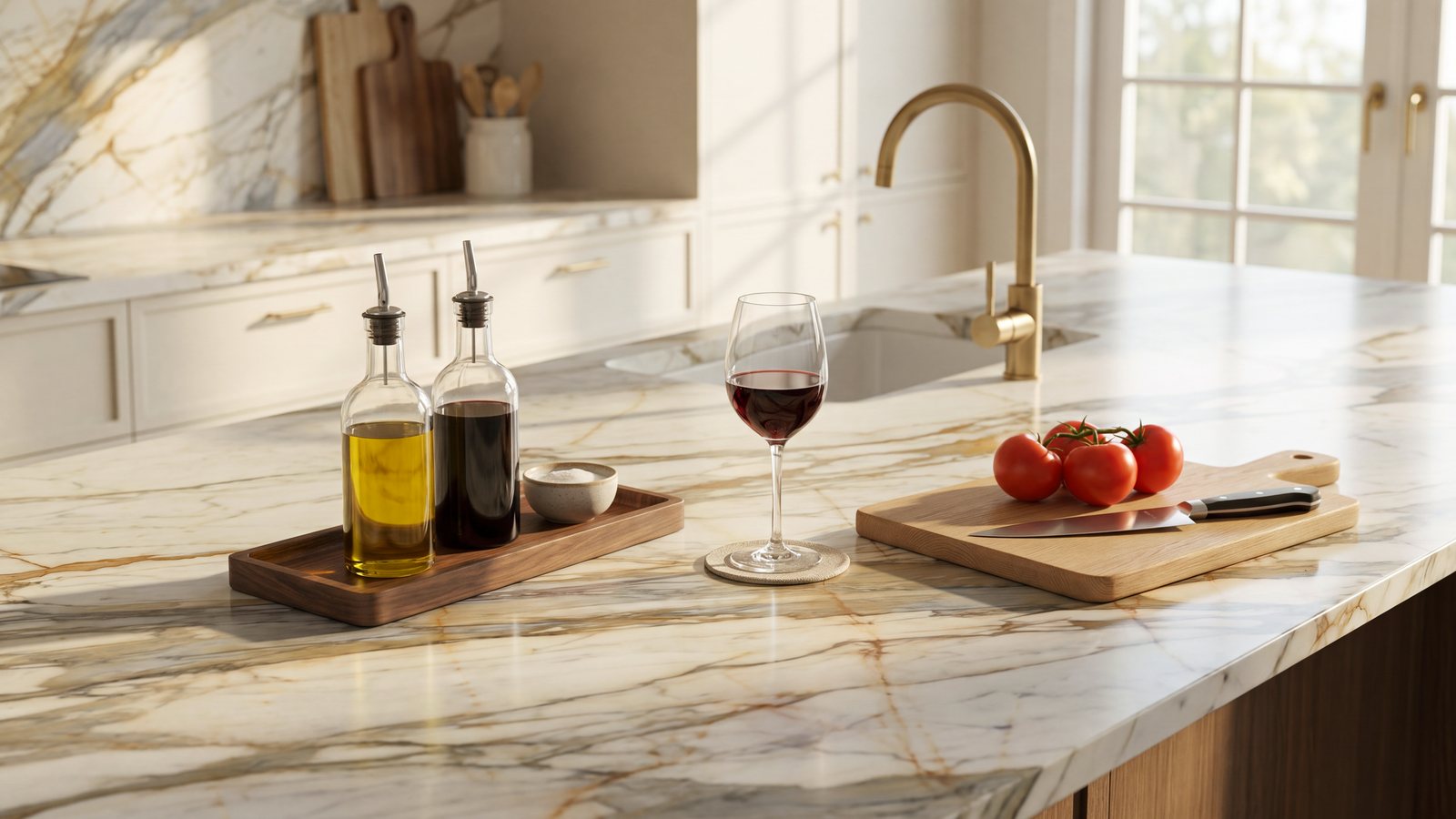
Lift trays and soap dishes now and then to wipe and dry underneath.
Living with patina
Not every etch needs fixing. Over time, light etches blend into an even patina, especially on honed marble. Our pros and cons of marble countertops frames the choice the same way: accept the maintenance or accept the patina.
Which Stones Etch
Any stone built on calcite reacts to acid: marble, limestone, onyx and travertine can etch within seconds. Granite is highly acid-resistant.
| Stone | Etches from kitchen acids? |
|---|---|
| Marble (calcite) | Yes, quickly |
| Limestone, travertine, onyx | Yes |
| Dolomite and dolomitic marble | Yes, more slowly |
| True quartzite | No |
| Granite | Highly resistant |
Dolomitic marble etches slightly more slowly than regular marble, geologist Karin Kirk explains in her guide to quartzite on Use Natural Stone. True quartzite does not etch from kitchen acids, so a “quartzite” that etches has been mislabeled.
Our dolomite countertops guide covers how dolomite behaves day to day. Rust removers with hydrofluoric acid, the Natural Stone Institute warns, attack every stone, granite and quartzite included.
Choosing Marble With Etching in Mind
Pacific Shore Stones has distributed natural stone since 2004 and carries marble across 16 showrooms in California, Texas, Oklahoma, Arkansas, Nevada and Mississippi.
In any of them you can compare polished and honed slabs side by side and ask the team how a specific stone will age.
Browse the marble collection, our guide to types of marble and the benefits of marble countertops. For repairs, contact a stone restoration professional. For everyday care, keep the Pacific Shore Stones stone care guides at hand.