
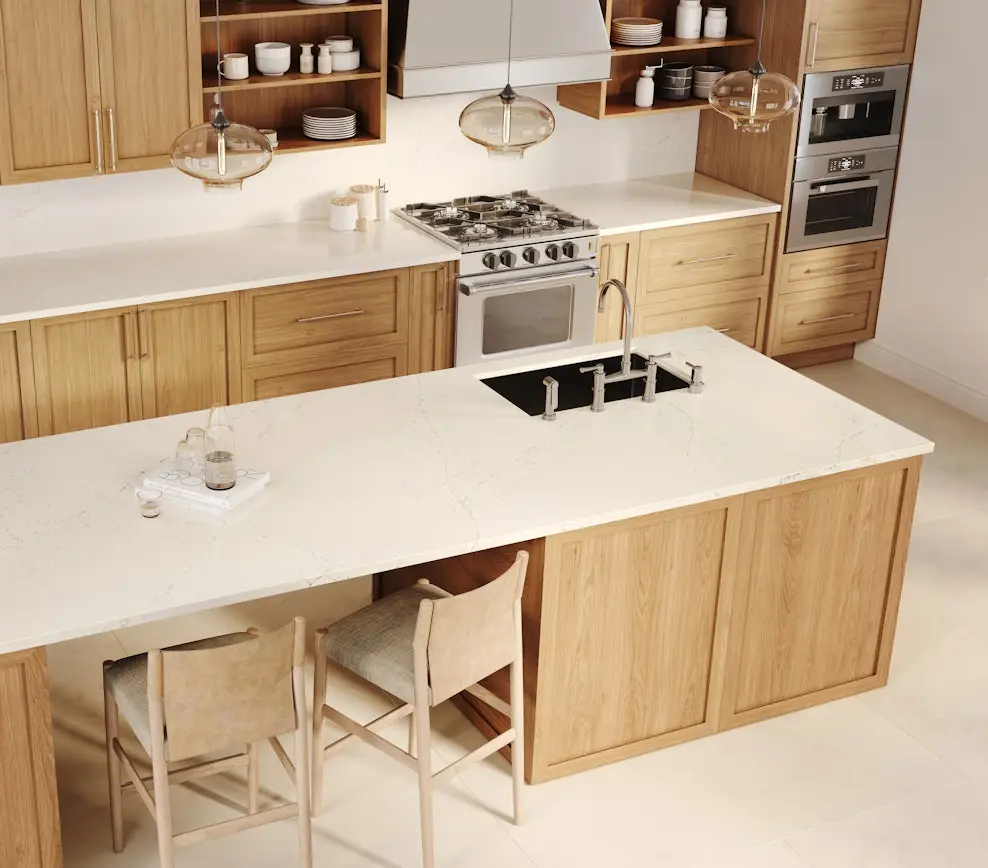
Silestone is one of the most requested countertop surfaces in Pacific Shore Stones showrooms, and the questions homeowners and designers bring are usually the same: what does it actually hold up to, what can it not handle, and what makes it different from the natural stone options sitting next to it on the counter. This guide answers those questions directly, starting with how the surface is made and ending with what it looks and feels like in a working kitchen.
What Silestone Is
Silestone is an engineered surface manufactured by Cosentino, the Spanish materials company that also produces Dekton. The surface is made from premium natural minerals with low silica content, recycled glass, and resins, compressed under vacuum into slabs of consistent dimensions and patterning.
The current formulation is built on Hybriq+ technology, which Cosentino introduced in 2021. Earlier versions of Silestone relied heavily on crystalline silica, raising occupational health concerns for fabricators exposed to silica dust during cutting and polishing. Hybriq+ reduces crystalline silica content to below 1% by weight, replacing it with recycled glass and other mineral composites. The practical outcomes for buyers are a denser, more uniform surface, a lower environmental footprint per slab, and a material Cosentino describes as a low-silica mineral surface rather than a silica-based one.
The surface is non-porous, which means no sealing is required and bacteria cannot penetrate the material itself.
Silestone in the Kitchen Countertops
The kitchen countertop is where Silestone’s engineered properties translate most directly into daily advantages. Its near-zero porosity is the foundation of most of them.
Non-Porous Surface and Kitchen Hygiene
Silestone’s near-zero porosity means the surface does not absorb moisture, liquids, or bacteria. This helps prevent bacterial growth on the countertop, making it safer for food contact and handling than more porous materials. Cleaning after raw meat prep or heavy cooking is a straightforward wipe-down rather than a deeper concern.
The non-porous surface also eliminates sealing entirely. There is no annual resealing schedule, no sealer degradation to watch for, and none of the ongoing maintenance task that natural stone countertops require.
Impact, Scratch, and Stain Resistance
Silestone’s mineral composition gives it strong resistance to scratches, stains from oil, wine, coffee, and household acids, and impact from typical kitchen use. Knife contact from everyday prep leaves the surface undamaged. Hard, angled impacts at edges or corners can chip the material, and those chips are difficult to repair in place.
The care failure Pacific Shore Stones sees most often is not the surface wearing down. It is mineral deposits from hard tap water building up near the sink on lighter-colored countertops. Wiping the sink area dry after use makes a visible difference over time.
Heat Resistance
Silestone resists thermal shock up to 356°F (180°C), per Cosentino’s published specifications. For incidental contact with warm cookware, the surface holds without damage. For sustained high-temperature contact, such as a cast iron pan resting directly on the surface for several minutes, trivets are recommended. The resin content in the material can discolor or crack under prolonged direct heat.
Full Body Design and Edge Options
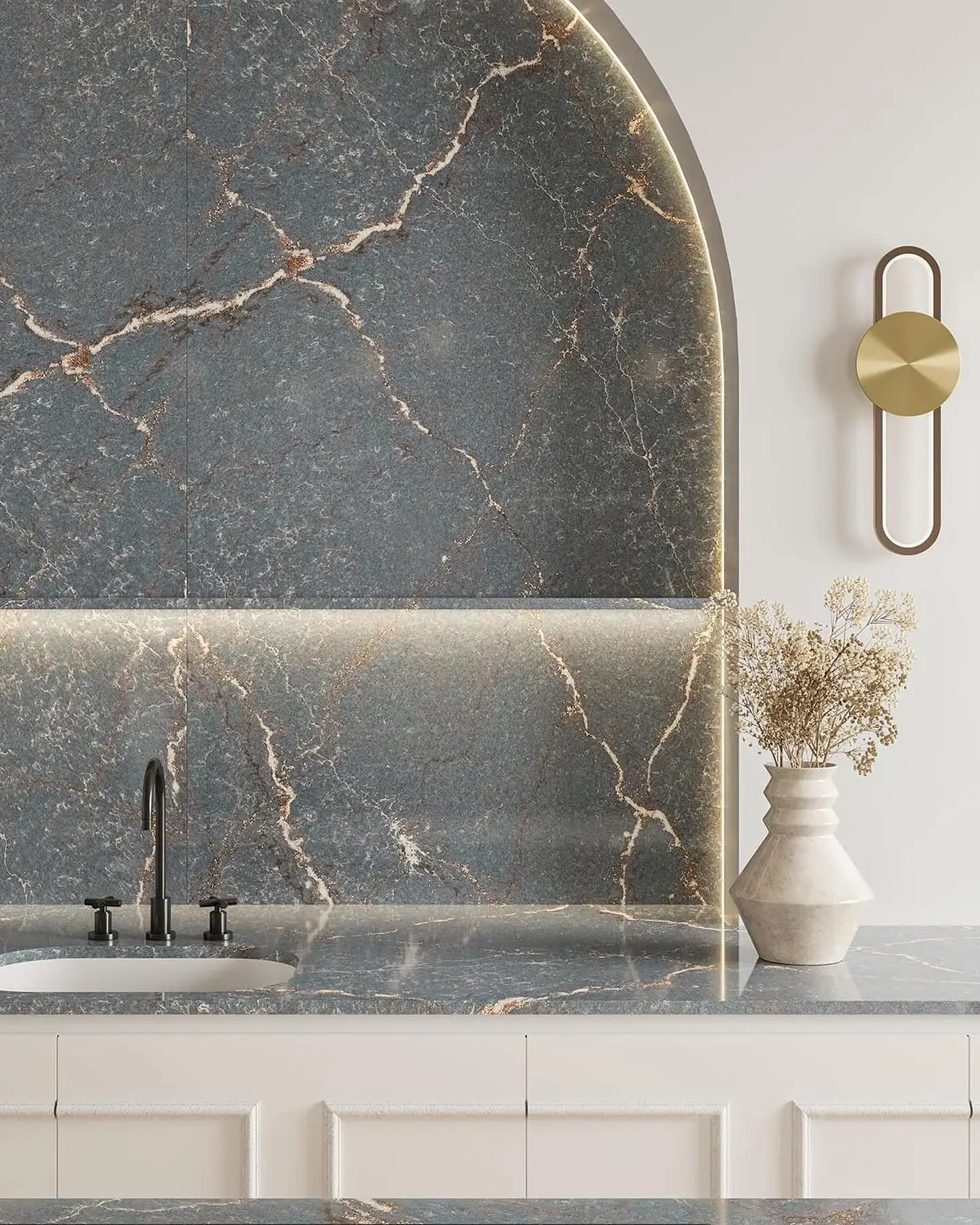
One of Silestone’s technically distinctive countertop properties is full vein continuity through the entire surface thickness. The veining that appears on the top surface runs through the full depth of the slab, remaining visible and continuous at edge cuts, sink cutouts, and recesses.
For countertop design, this opens edge options that surfaces with a solid-colored interior do not allow. Mitered edges, waterfall islands, routed grooves, and decorative slots all reveal the slab’s interior as part of the design rather than exposing a separate core color. Fabricators can work with shark nose, ogee, demi-bullnose, miter, and other profiles without the pattern discontinuity that appears in some other engineered surfaces.
Slab Formats and Thicknesses
Silestone is available in two slab formats: standard (118.9 x 55.1 inches) and Jumbo (125.98 x 62.6 inches). The larger format reduces the number of seams needed in kitchen islands and long countertop runs, a meaningful practical advantage in high-visibility applications.
Available thicknesses are 12mm, 20mm, and 30mm, allowing different design weights and installation types. Thicker profiles read as more substantial and suit designs leaning toward the material-forward kitchen aesthetic common in current high-end remodels.
Silestone Integrity: Countertop and Sink as One Piece
Cosentino’s Integrity concept produces countertops and sinks from the same slab of Silestone, creating a monolithic surface with fewer seams. Because the sink and counter are one piece of material with the same near-zero porosity throughout, there are no joint lines for moisture to collect in, and the maintenance approach is identical across the whole surface.
Pacific Shore Stones carries Integrity configurations alongside the standard slab selection. For clients prioritizing hygiene and a clean installation, it is worth seeing alongside the countertop options before making a final decision.
Finish Options
Silestone is available in three surface finishes, each suited to a different kitchen environment and usage level.
Polished
The classic Silestone finish. High gloss, smooth to the touch, and the setting where veining and color depth read most vividly. Polished shows watermarks near the sink more readily than the other finishes and shows fingerprints on darker colors. For kitchens that want maximum visual impact and are prepared to maintain it, it is the right choice.
Suede
Matte-textured finish with a soft, slightly velvety feel. Suede hides minor watermarks and fingerprints better than Polished and suits contemporary and transitional kitchens where a lower-sheen aesthetic is intentional. This finish is increasingly specified for kitchen islands at Pacific Shore Stones, where the countertop sees high daily contact and a forgiving surface reads better over time.
Volcano
A rougher, more textured surface, close to the feel of a honed natural stone. Volcano is popular for outdoor kitchen countertops and applications where visual texture is a design priority. More forgiving of heavy daily use than Polished in terms of surface marks showing, and one of the more distinctive looks in the Silestone lineup.
Care and Cleaning
Routine Silestone countertop cleaning requires only mild dish soap and a damp cloth. No specialty stone cleaner is needed, and no periodic sealing. Cosentino confirms that diluted household bleach is safe for occasional disinfection.
The Clorox wipe question comes up regularly: occasional disinfecting use is fine. Concentrated disinfectant wipes used daily can degrade the surface finish over time. For routine cleaning, soap and water is the right tool.
Seeing Silestone at Pacific Shore Stones
Silestone reads differently in a showroom than it does on a screen or in a product catalog. Pacific Shore Stones carries Silestone across our 17 showroom locations, alongside our full natural stone inventory.
Visit our Silestone brand page for current collections, or stop into any of our locations to see the Integrity sink configurations and the full range of finishes in person.