
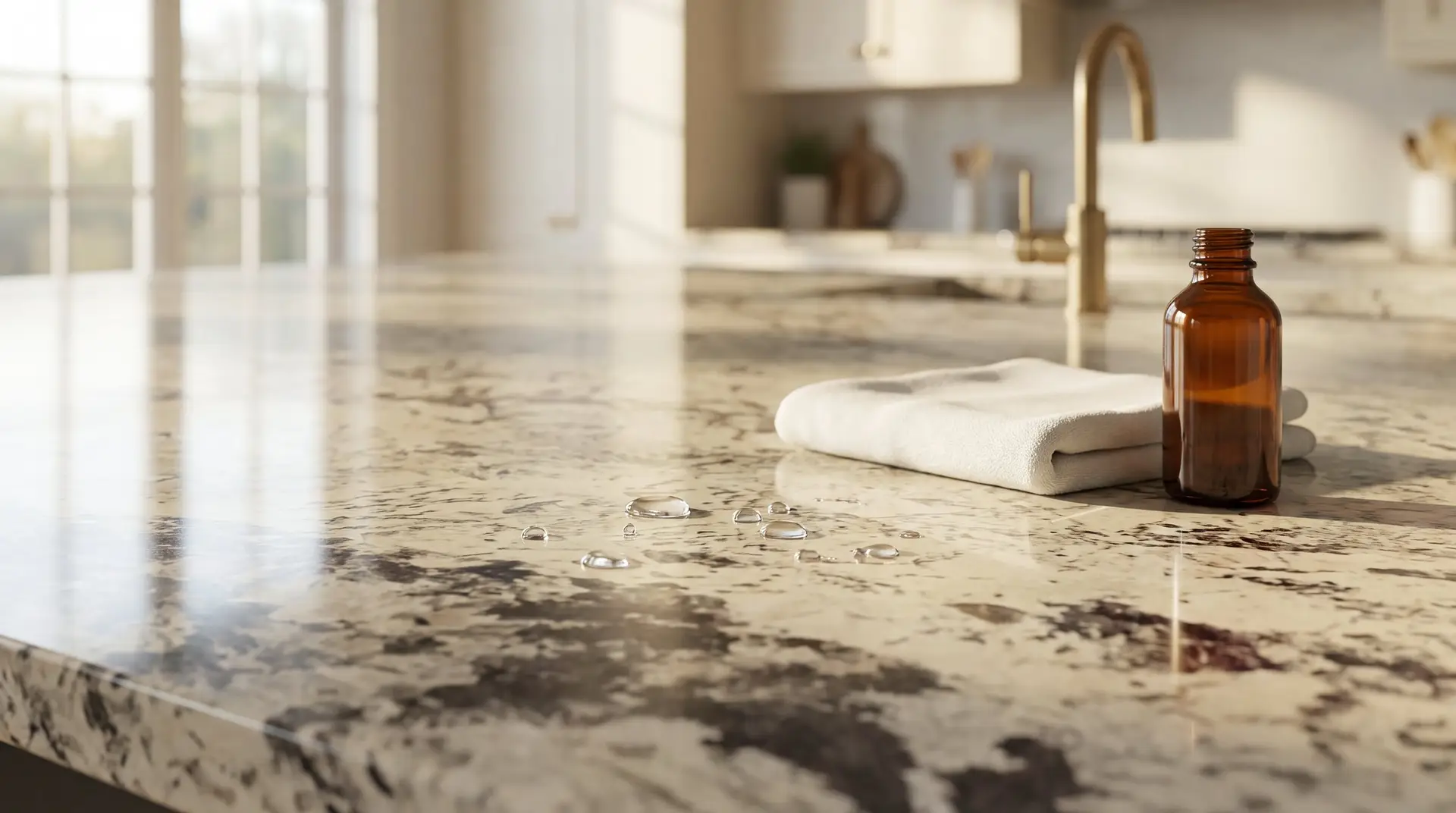
Here is how to seal granite countertops: run a 15-minute water test first. If the stone darkens, clean and dry the counter, apply a penetrating sealer in small sections, wipe off all the excess and let it cure.
The Pacific Shore Stones Granite Care Guide states the rule simply. Granite should be sealed after installation and resealed as needed. The water test tells you what “as needed” means for your slab.
How to Tell If Granite Needs Sealing
The Pacific Shore Stones care guide uses one check that works on new and old countertops:
- Wipe the test areas clean and let them dry.
- Pour a small puddle of water in a few places, especially near the sink and cooktop.
- Leave the water for about 15 minutes.
- Wipe it away and look at the stone at a low angle. If it has darkened, it may be time to reseal.
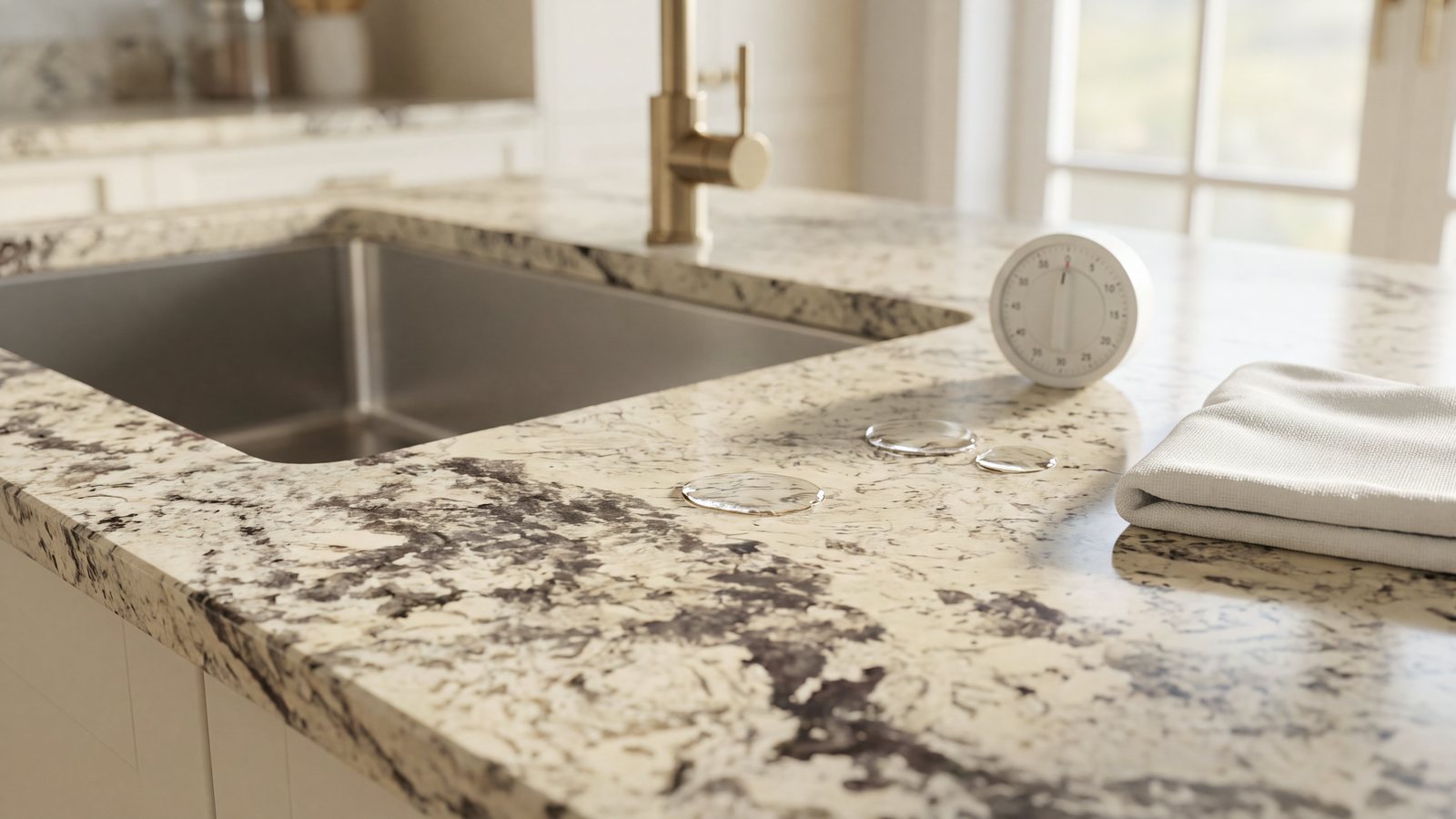
A dark patch from water is not a stain. It fades as the stone dries. If you cook with a lot of oil, test a few drops of oil nearby at the same time, since oil leaves the most lasting marks.
| What you see after 15 minutes | What to do |
|---|---|
| Water beads and the stone looks unchanged | Nothing. Test again in a few months |
| A shadow only near the sink or cooktop | Reseal those areas |
| Dark rings in several spots | Clean, dry and seal the whole countertop |
| The stone darkens almost immediately | Seal, and expect more than one coat |
Does Granite Need to Be Sealed?
Not always. Granite is a family of stones, and porosity changes from one quarry to the next. The Natural Stone Institute’s technical data on granite shows low but variable water absorption.
Its position statement on sealing countertops says most granite countertops do not need sealing. Many still benefit from it, because sealing further reduces moisture movement into the stone.
Color is a rough clue. Dense dark stones such as Absolute Black, Ubatuba and Black Galaxy tend to absorb very little. Lighter stones such as Kashmir White and River White tend to absorb more. If you have Absolute Black granite or any other dark stone, let the test decide.
Two more factors change how much sealer a countertop will take:
- Resin treatment. The Natural Stone Institute notes that many granites are resin-treated at the factory to fill micro-fissures. A resined, polished surface can accept very little sealer.
- Finish. Honed and leathered surfaces are more open than polished ones. As our guide to polished, honed and leathered finishes explains, honed finishes need resealing more often.
Choosing a Granite Sealer
Most “granite sealers” are impregnators that repel liquids, according to the Natural Stone Institute. They make stone more stain resistant, not stain proof.
| Sealer type | How it works | Right for a countertop? |
|---|---|---|
| Penetrating (impregnating) | Soaks into the pores and cures below the surface | Yes. The standard choice |
| Topical (coating) | Forms a film on top of the stone | Usually not. Penetrating sealers last longer |
| Color-enhancing | A penetrating sealer that deepens the color | Only if you want the stone darker. Test first |
Read the label before you buy. It confirms the sealer suits granite and sets the dwell time, number of coats and cure time.
How to Seal Granite Countertops Step by Step
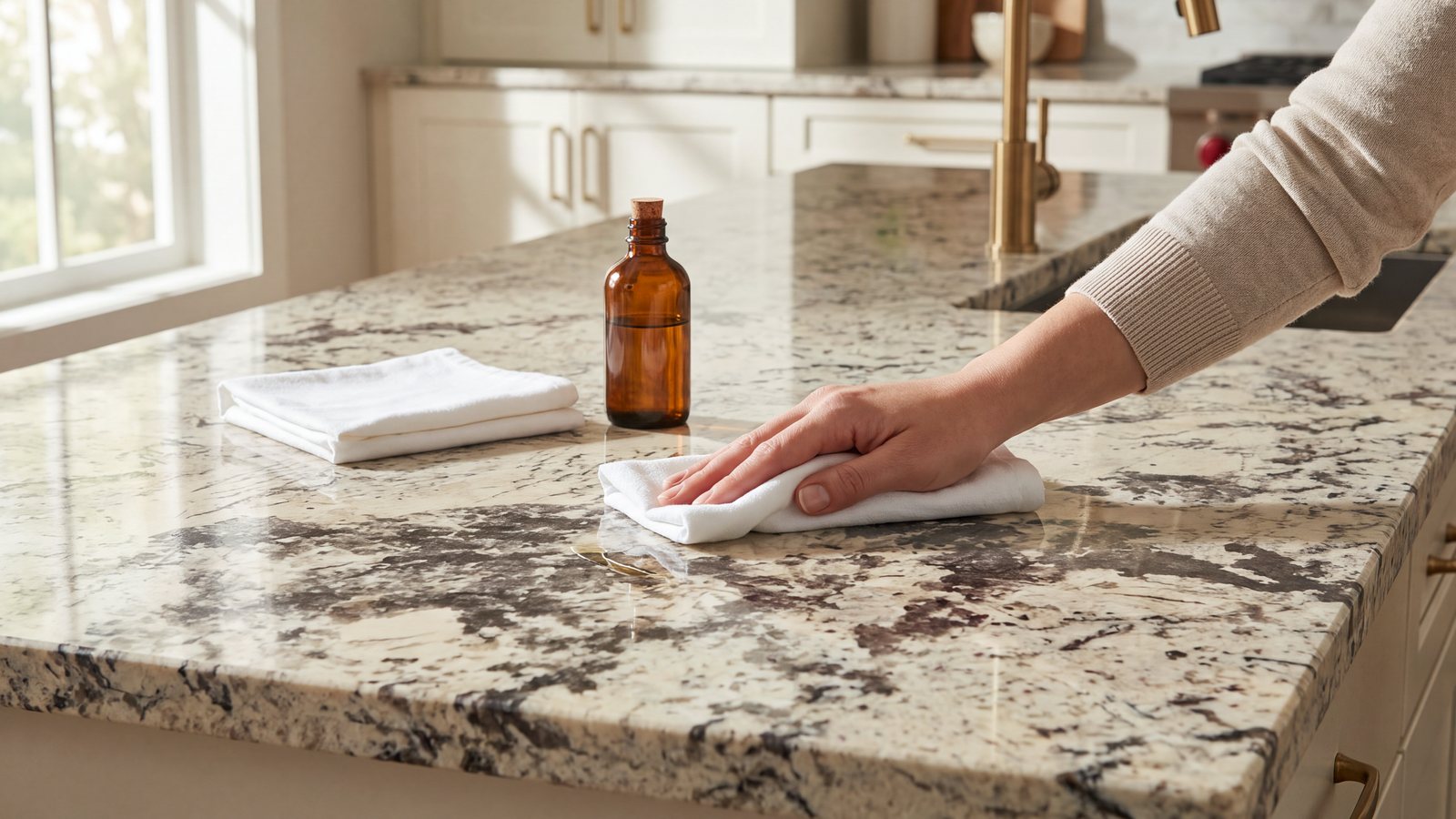
You need a penetrating sealer labeled for granite, a stack of clean, lint-free cloths, gloves and a day without using the counter.
- Clean the counter. Wash with a few drops of mild dish soap in warm water, rinse and dry. Remove any stain first, because sealing over it locks it in.
- Let the stone dry completely. Overnight is the easy rule. Moisture in the pores keeps sealer out.
- Test the sealer on a hidden spot. Check for dark blotches, cloudiness or a color shift before doing the whole counter.
- Apply in small sections. Work about an arm’s length at a time and wet the surface evenly. Give the edges a second pass, and seal under the sink lip too.
- Let it dwell and keep it wet. Follow your sealer’s label, typically 5 to 30 minutes. Add sealer to any spot that starts to dry.
- Wipe off all the excess. Use clean, dry towels and refold them often. A saturated towel spreads sealer instead of removing it.
- Add a second coat only if the stone drank the first. Follow the label, typically 30 minutes to one hour after the first coat. If the sealer just sits on top, the stone is full, so wipe it off and stop.
- Let it cure, then retest. Follow your sealer’s label, typically light use after several hours and a full cure in 24 to 72 hours.
Run the 15-minute water test again after the cure.
Sealing New Granite Countertops
New granite should be sealed after installation, according to the Pacific Shore Stones care guide. First ask your fabricator whether the stone was already sealed, and whether the cut edges and sink cutout were treated.
Factory resin does not reach those cut surfaces, and the sink cutout takes the most water. If the counter already beads everywhere, you may not need to do anything yet.
How to Fix Sealer Haze
Haze is the most common sealing mistake. When dense granite gets more sealer than it can absorb, the excess dries into a white film that looks like hard-water deposits.
If you catch it within the first several hours, reapply a little sealer to soften the film and wipe the area completely dry. Older haze needs the residue cleaner the sealer’s maker recommends, then a fresh, properly wiped coat. If the haze survives that, call a stone restoration professional instead of scrubbing.
More coats do not mean more protection. Sealing stone that cannot take more leaves a dull coating that scratches more easily than the stone. Dense dark granites and resin-treated slabs are the usual victims, which is why the water test comes first.
How Often to Seal Granite Countertops
There is no fixed schedule. It depends on the stone, the finish and the sealer.
The Pacific Shore Stones guide gives the practical rule: reseal when the stone darkens in the water test. Test every few months near the sink and cooktop, where sealer wears first.
What Happens If You Don’t Seal Granite?
On dense granite, probably nothing. On absorbent stone with worn sealer, the care guide warns that oil, wine, coffee and colored drinks can soak in.
The Natural Stone Institute adds that a homeowner who cleans the countertop after each meal will rarely, if ever, have staining issues with granite. Quick cleanup does a lot of the work.
Sealing reduces absorption. It does not make granite stain-proof, heat-proof or scratch-proof, so keep using cutting boards, trivets and coasters. For the daily routine, see our guide on how to clean granite countertops.
When to Call a Pro
Knowing how to seal granite countertops is enough for most homeowners. The only real skill is wiping off every bit of excess before it dries.
Call a stone restoration professional when the counter needs more than sealer: set-in stains, a dull finish or haze you cannot remove. That is restoration work, done before resealing.
Pacific Shore Stones distributes granite and other natural stone through 16 showrooms in California, Texas, Oklahoma, Arkansas, Nevada and Mississippi. It does not fabricate, install or seal countertops, but the team can explain how a specific stone behaves before you choose it.
Browse the granite collection, read granite basics or find a showroom near you. Keep the Pacific Shore Stones stone care guides handy once the countertop is in.