

Porcelain slabs are not a single category. They span from sintered stone — fused at 1,200°C+ under 25,000 tons of pressure — to premium large-format porcelain manufactured by Italian, Spanish, and Korean engineers. For a homeowner or designer choosing a countertop, the real decision is less “porcelain yes or no” and more “which brand’s technology and design library fits this specific project.”
This guide walks through the six porcelain slab brands Pacific Shore Stones distributes across its 17 showrooms: Neolith, Dekton, Éclos by Cosentino, Atlas Plan, Porcelanosa, and LX Teracanto. We cover what each is made of, what sets it apart, and when to specify it.
Porcelain Slab vs. Sintered Stone: What’s Actually Different
Porcelain is an engineered ceramic made by firing a blend of kaolin, feldspar, and quartz at high temperatures until the material vitrifies into a dense, non-porous surface — details documented on the Pacific Shore Stones porcelain page. Sintered stone pushes that process further. The particles are fused at roughly 1,200°C under tens of thousands of tons of pressure until they bond at a molecular level, producing near-zero porosity and a hardness that rivals granite.
Every slab in this guide is a porcelain surface. Three of them — Neolith, Dekton, and Éclos — also qualify as sintered or ultra-compact mineral surfaces. The remaining three — Atlas Plan, Porcelanosa, and LX Teracanto — are premium large-format porcelain slabs that share the heat resistance, stain resistance, and design versatility of porcelain without the specific ultra-compaction process that defines sintered stone.
If you want the full technical breakdown of how sintered stone is made, see our companion guide: What Is Sintered Stone? Benefits and Brands.
The 6 Best Porcelain Slab Brands
1. Neolith — The Sintered Stone Pioneer
-
Origin: Spain
-
Composition: 100% natural raw materials; up to 98% recycled content in select models, with no added silica sand
-
Key technology: NeolEAT antibacterial surface, resistance to UV, heat, and scratching
-
Thickness range: from 3 mm ultra-thin to 12 mm and 20 mm for countertops
-
Warranty: 25 years for residential countertops in 12 mm and 20 mm, subject to registration within 6 months of purchase
-
Best for: Outdoor kitchens, facades, designer-forward residential kitchens, pool surrounds
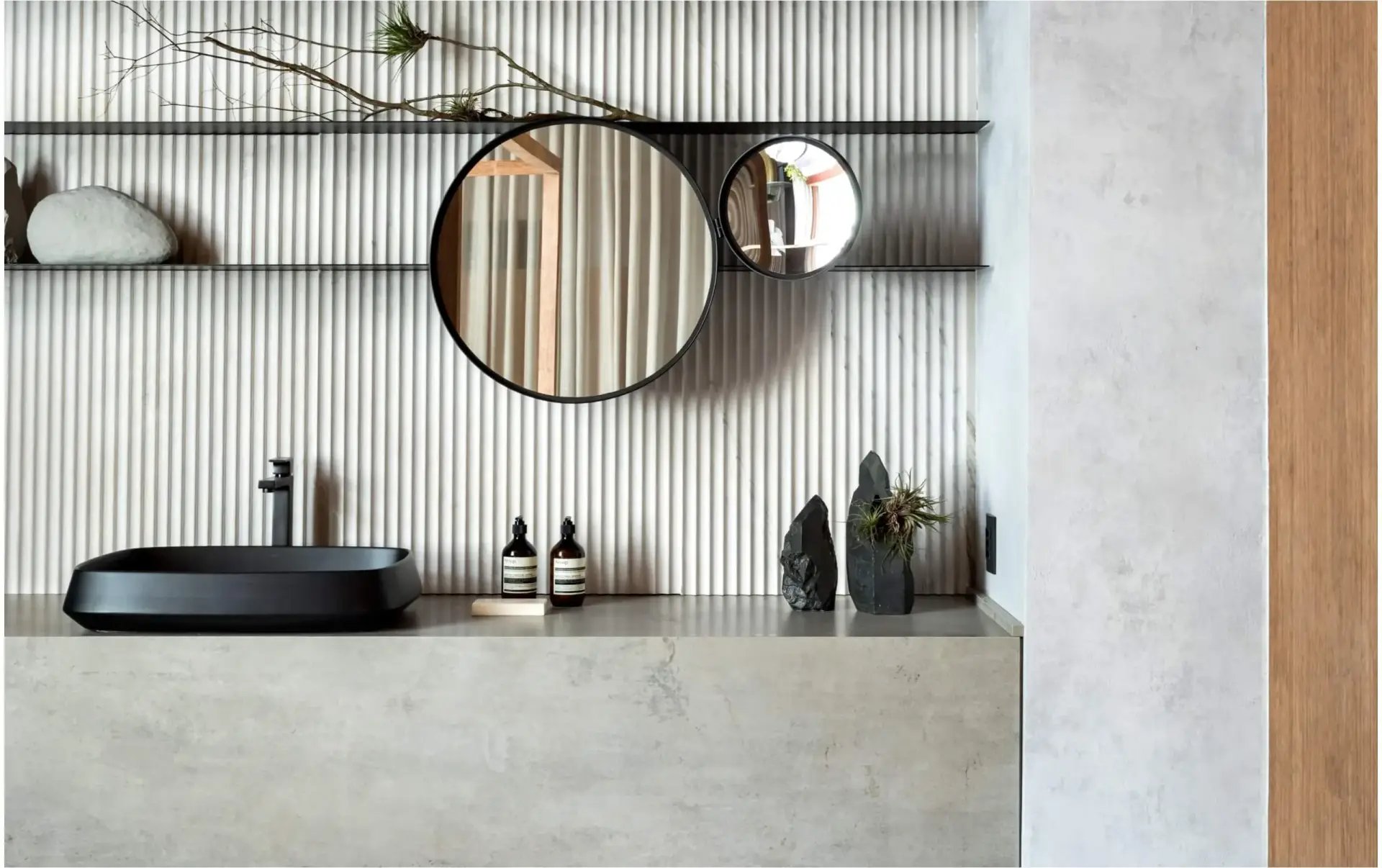
Neolith created the modern sintered stone category and still sets the pace. The brand’s Spanish plant produces slabs with what it calls near-zero porosity, which is why Neolith is used on facades, pool decks, and outdoor countertops where weather exposure would break down a lesser surface. The 3 mm ultra-thin format is unusual in the porcelain slab world and is commonly specified for cladding and vertical surfaces where weight matters.
The 98% recycled content claim is specific to certain models, not the entire catalog — worth confirming on the specific slab you’re considering. For a deeper look at the brand, see our Neolith countertops review. Pacific Shore Stones stocks Neolith across multiple showrooms; full slabs are viewable via our Neolith brand page.
2. Dekton by Cosentino — Ultracompact and Carbon Neutral
-
Origin: Spain (Cosentino Group)
-
Composition: raw materials common to glass, porcelain, and quartz surfaces
-
Key technology: TSP (Sinterized Particle Technology); 25,000 tons of ultra-compaction pressure
-
Thickness range: four thicknesses available for indoor and outdoor applications
-
Warranty: residential warranty through Cosentino (see brand terms)
-
Best for: Technical-spec-driven projects, clients who care about measurable sustainability, facades and outdoor applications
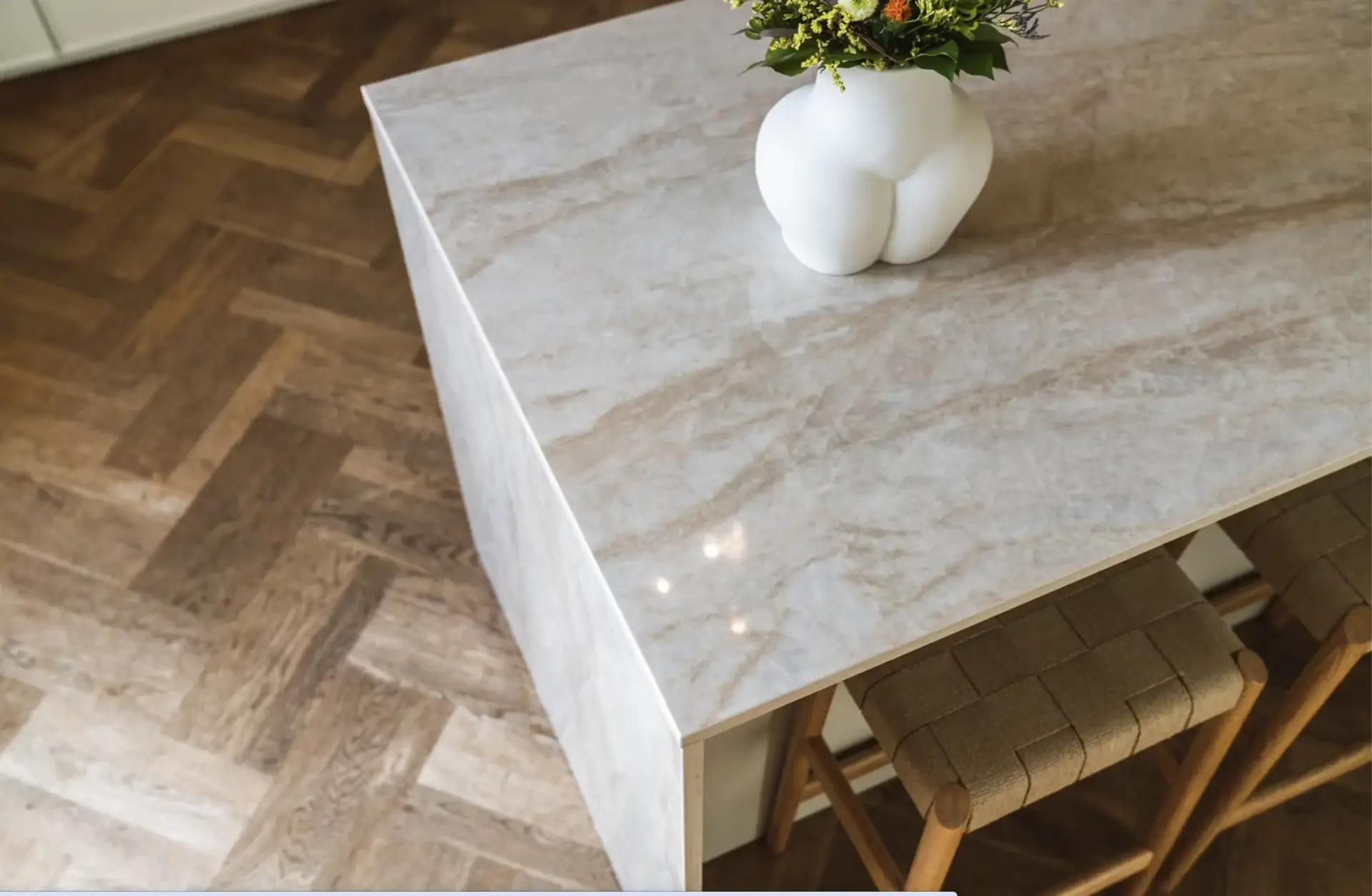
Dekton sits at the intersection of performance engineering and sustainability credentials. Its manufacturing press applies 25,000 tons of uniform pressure — roughly 2.5 times the weight of the Eiffel Tower — which eliminates the microdefects that cause weak points in standard porcelain. The result is a slab Cosentino describes as harder than granite.
What sets Dekton apart from other porcelain brands is its third-party verified sustainability status. Cosentino offsets 100% of CO2 emissions across the full product life cycle, uses 100% renewable electricity in production, and has its carbon footprint verified by MITERD, the Spanish Ministry for Ecological Transition. Cosentino markets Dekton as the only Cradle-to-Grave carbon neutral surface in its category. If a project’s spec sheet includes LEED points or client-mandated carbon disclosure, Dekton has a defensible paper trail.
3. Éclos by Cosentino — The Newcomer with Zero Crystalline Silica
-
Origin: Spain (Cosentino Group)
-
Composition: mineral surface with more than 50% recycled materials; some colors approaching 90% recycled content; zero crystalline silica
-
Key technology: INLAYR® layered design system; 3D veining through advanced robotics
-
Heat resistance: withstands direct cookware contact up to 220°C / 428°F
-
Best for: Interior kitchens and bathrooms where fabricator silica exposure matters; specifiers prioritizing the newest surface technology
Éclos is the most significant launch in the porcelain category in recent memory — and it matters for reasons that go beyond aesthetics. Cosentino announced the global launch in October 2025, and the brand arrived at Pacific Shore Stones on April 15, 2026.
The headline feature is its composition. Éclos was formulated without crystalline silica, which addresses intensifying scrutiny of silica exposure risks in fabrication shops. OSHA’s permissible exposure limit for respirable crystalline silica has driven ongoing fabricator safety debates across the stone industry; Éclos sidesteps that question entirely by not containing the material in the first place.
The INLAYR® technology is the second differentiator. Instead of printing a pattern on the surface, Éclos uses layered robotics to build 3D veining into the body of the slab, so the veining shows genuine depth rather than a flat image. Combined with up to ~90% recycled content in some colors and 220°C heat tolerance, it’s a serious contender for interior kitchens and bathrooms.
Éclos is positioned for interior applications; for outdoor kitchens and facades, Neolith or Dekton remain the stronger spec.
4. Atlas Plan by Atlas Concorde — Italian Large-Format
-
Origin: Italy (Atlas Concorde group)
-
Composition: non-porous porcelain with through-body veining technology
-
Key technology: Natura Vein and Natura Body — veining extends through the slab, not just the surface
-
Finishes: marble, concrete, and metal looks across multiple thicknesses
-
Best for: Large continuous surfaces — feature walls, oversized islands, facades, hospitality interiors
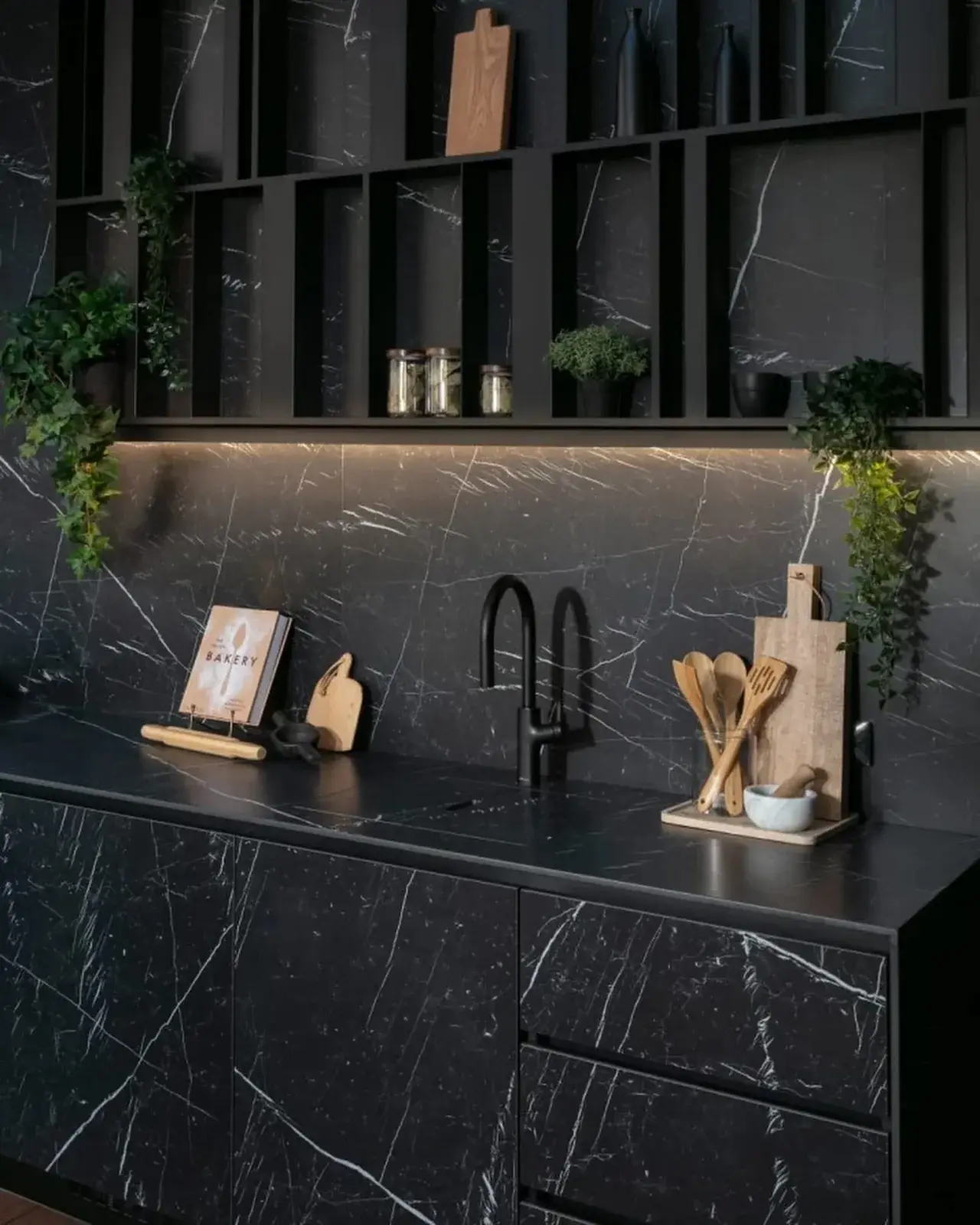
Atlas Plan is the large-format arm of Atlas Concorde, one of Italy’s long-established ceramic producers. The brand’s calling card is its through-body veining: unlike standard porcelain where the pattern is printed on the surface, Atlas Plan’s Natura Vein and Natura Body technologies carry the veining continuously from face to core, so the pattern holds up when a fabricator profiles a mitered edge or a sink cutout.
Designers in our showrooms specify Atlas Plan when they want continuous visual runs across large surfaces — bookmatched feature walls, oversized kitchen islands, or facade panels where seams would be visible. The catalog leans heavily into realistic marble, concrete, and metal looks. For a design-focused look at what the material can do, our team wrote five ideas for Atlas Plan porcelain, and full slabs are viewable on the Atlas Plan brand page.
5. Porcelanosa — Spanish Heritage Since 1973

-
Origin: Spain (Villarreal, on the Mediterranean coast)
-
Composition: porcelain stoneware built on white clay, pioneered by founder Pepe Soriano
-
Scale: products distributed across 143 countries through hundreds of company-owned showrooms
-
Design range: ceramic wall tiles, porcelain floor tiles, slabs, natural stone, hardwood, and mosaics
-
Best for: Whole-home specification where one brand can supply tile, slab, and mosaic in coordinated finishes
Porcelanosa occupies a different position than the other five brands in this roundup. It’s not specifically a sintered stone or a large-format slab specialist — it’s the broadest porcelain and ceramic manufacturer on the list, building on more than five decades of production. Since 1973, the brand has grown from a small Spanish workshop into a global manufacturer distributed across 143 countries.
The founder’s commitment to white clay as the base raw material is the spec detail that distinguishes Porcelanosa from tile manufacturers using standard red or buff clays. White clay produces denser tiles with cleaner finishes and more consistent color through the body of the material. Within the Pacific Shore Stones catalog, Porcelanosa is most often specified when a project needs coordinated materials across multiple rooms — a Porcelanosa kitchen floor, wall tile, and backsplash that visually reference each other while each piece is optimized for its role.
6. LX Teracanto by LX Hausys — Thru Vein and Bookmatched
-
Origin: South Korea (LX Hausys)
-
Composition: 100% natural raw materials; no resins, fillers, or synthetic additives
-
Key technology: Thru Vein Technology on select stones; bookmatched slabs
-
Thickness range: 1.2 cm across all colors; 2 cm on Calacatta Gold with Thru Vein
-
Certifications: Greenguard Gold (low-emitting product)
-
Recognition: Teracanto Superior White won a 2025 GOOD DESIGN Award
-
Best for: Bookmatched statement installations; food-contact applications; projects prioritizing low-VOC material selection
LX Teracanto is the porcelain arm of LX Hausys, one of Korea’s largest materials manufacturers. The brand positions itself around two technical differentiators worth understanding.
First, composition: Teracanto is manufactured without resins, fillers, or synthetic additives — which means it can be specified for direct food preparation without concerns about chemical migration. Most quartz surfaces contain 7–10% polymer resin as a binder; Teracanto doesn’t contain any, putting it closer to sintered stone in terms of composition purity.
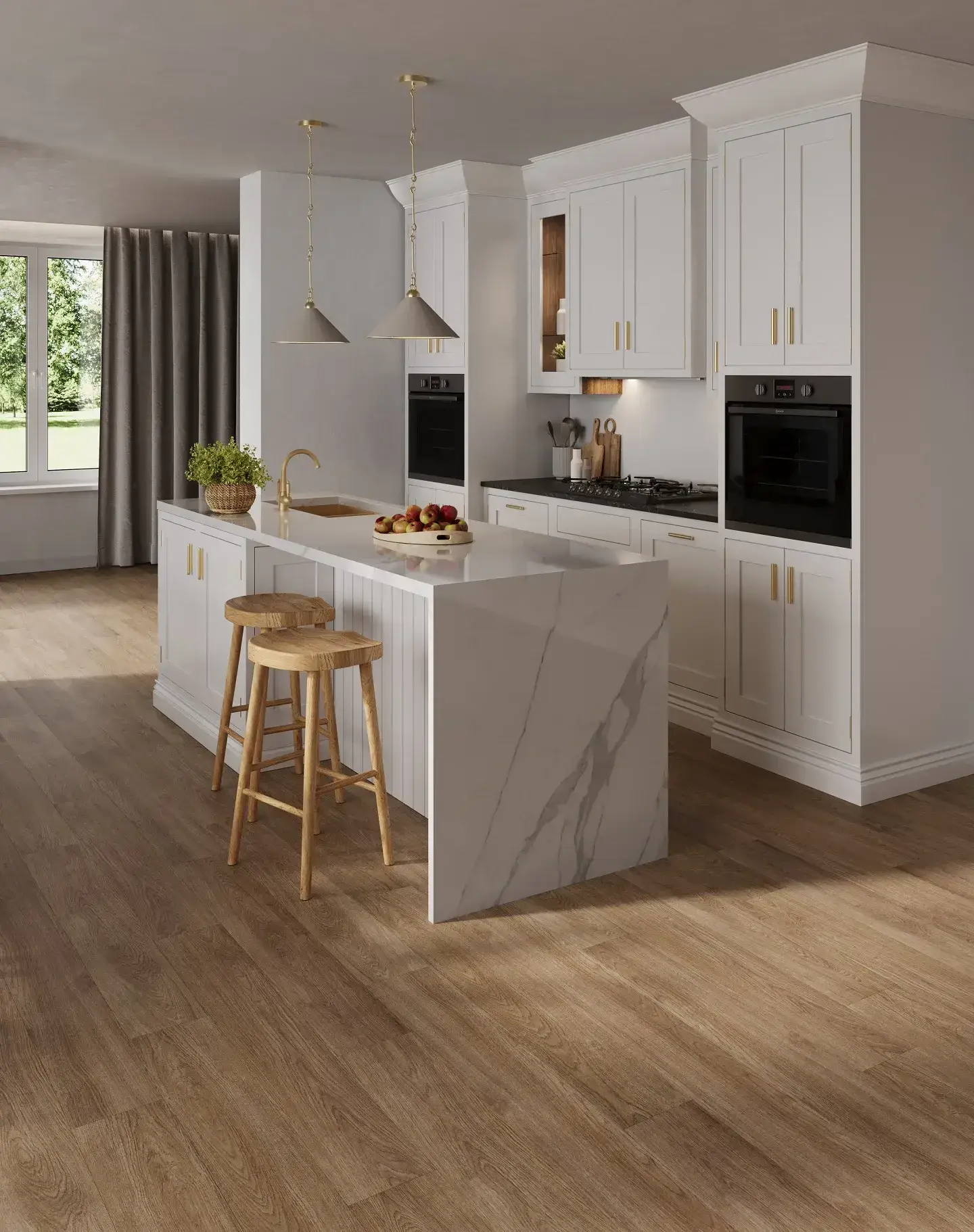
Second, Thru Vein Technology extends veining through the full body of select slabs, not just the surface — similar in principle to Atlas Plan’s through-body approach, but implemented on a different slab geometry. The 1.2 cm format is particularly useful for walls, backsplashes, and cladding where weight matters; Calacatta Gold in the 2 cm version is the countertop spec. Pacific Shore Stones carries LX Teracanto across multiple showrooms for full-slab viewing.
Choosing the Right Porcelain Brand for Your Project
Start with the use case, not the brand.
-
Outdoor kitchens, pool decks, or facades — specify Neolith, Dekton, or Atlas Plan. All three handle UV exposure and temperature swings without fading or breaking down.
-
Silica-safe fabrication is non-negotiable — Éclos is the only brand on this list formulated without crystalline silica.
-
A bookmatched statement wall or oversized island — LX Teracanto (bookmatched slabs, Thru Vein) and Atlas Plan (Natura Body through-body veining) are purpose-built for this.
-
Sustainability as a deliverable — Dekton has the carbon-neutral certification; Éclos has the highest recycled content ceiling (up to ~90% in some colors); Neolith claims up to 98% recycled in select models.
-
Highest-hardness countertop for daily heavy use — Neolith and Dekton lead on measurable hardness, with Dekton specifically marketed as harder than granite.
In our 17 stores across six states, we see these same patterns repeat: designers arrive with a use case, and the brand roster narrows fast once the use case is clear.
How Porcelain Compares to Quartz and Quartzite
Porcelain isn’t the only premium countertop category worth considering. Quartz is an engineered surface made of ground quartz crystals bound with 7–10% polymer resin — strong on design consistency, weaker on heat resistance because the resin can scorch. Quartzite is a natural stone that forms when sandstone metamorphoses under pressure and heat — comparable in hardness to granite, typically requiring periodic sealing.
If you’re still choosing between these categories, our quartz vs. quartzite comparison walks through the tradeoffs in detail.
Experiencing These Brands in Person
Photos and spec sheets only carry you so far. Veining depth, how the surface catches light, and how a bookmatched pair reads across a full island are details that reveal themselves only in person. Schedule a showroom visit to compare full slabs of Neolith, Dekton, Éclos, Atlas Plan, Porcelanosa, and LX Teracanto side by side — or check live inventory by location before you go.