
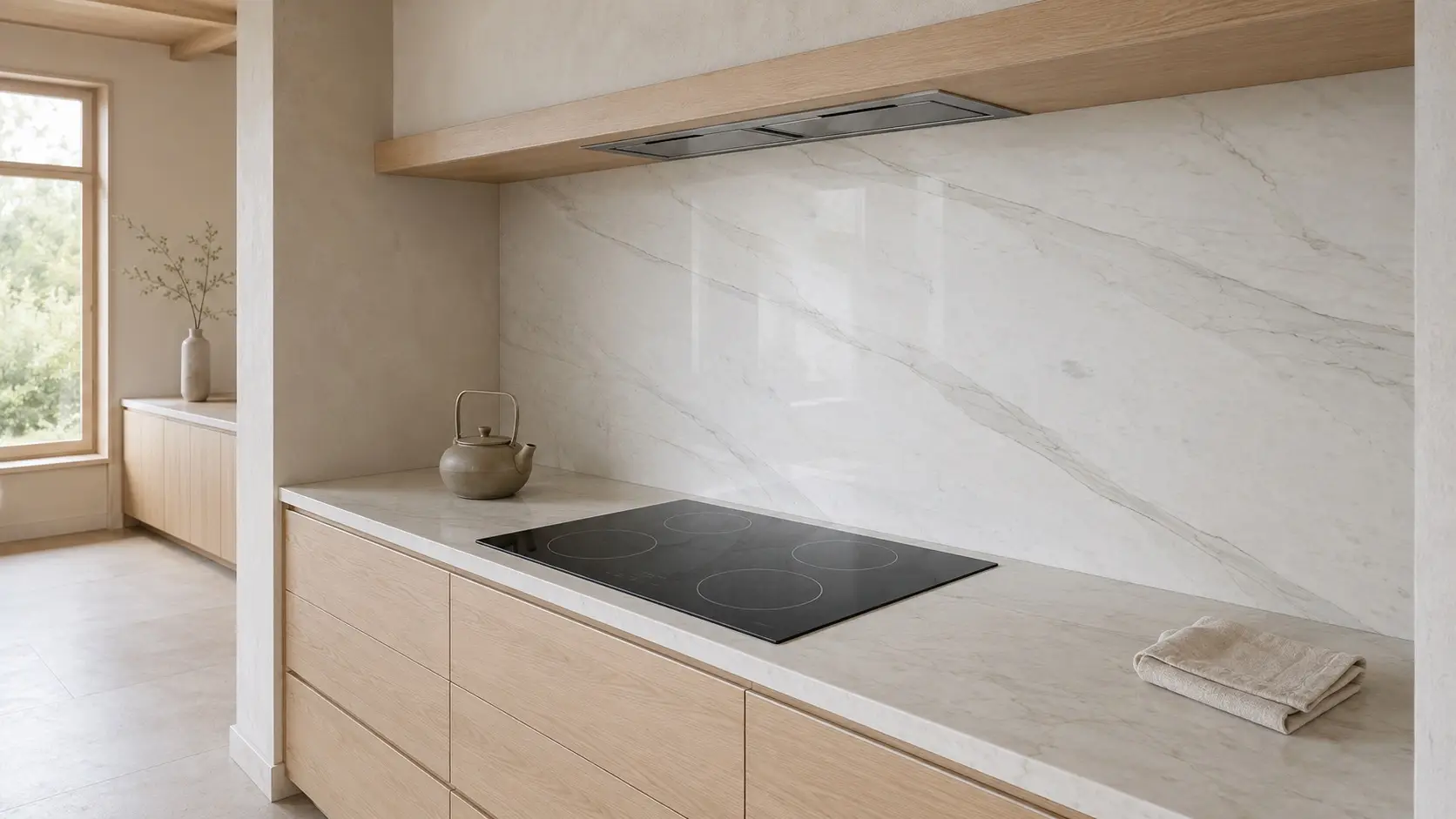
A Calacatta Gold backsplash turns the wall behind the counter into the most looked-at surface in the kitchen. Its bright white background and warm gold veining sit right at eye level, where they read as a designed feature rather than a work surface, and a single full-height slab behind the range becomes the room’s centerpiece.
This guide walks through slab versus tile, the design moves that make it look high-end, and the one spot that needs a plan, drawing on the Calacatta Gold Pacific Shore Stones distributes across 17 showrooms.
What Calacatta Gold Is
Calacatta Gold is best known as a natural marble, a calcite stone with a bright white background and warm gold veining that comes from iron oxides, quarried in Italy’s Carrara marble region. The name travels beyond the marble, though.
The same look is reproduced in engineered surfaces, so “Calacatta Gold” can mean the natural marble, a porcelain slab like Atlas Plan’s, or an engineered surface like Silestone’s. Pacific Shore Stones carries all three, which matters for a backsplash: the natural marble for its depth, and the non-porous versions for the one zone that works hardest. The rest of this guide focuses on the natural marble slab, and flags the engineered option where it earns its place.
Full-Height Slab vs. Tile for a Calacatta Gold Backsplash
The two ways to do a Calacatta Gold backsplash look and behave very differently:
-
Full-height slab. A single slab running from the counter to the hood or ceiling is the luxury version. With no grout lines to interrupt it, the veining flows as one sheet, and it wipes clean easily because there’s no grout to trap grease.
-
Slab at standard height, or tile. A shorter run of slab above the counter gives the seamless look on a smaller footprint. Calacatta Gold also comes as porcelain tile, which reintroduces grout lines that break the veining into pieces and, behind a stove, catch grease.
If you’re weighing this against other options, our guide on backsplash colors is a useful companion.
Design Ideas: Bookmatching, Matching, and Contrast
-
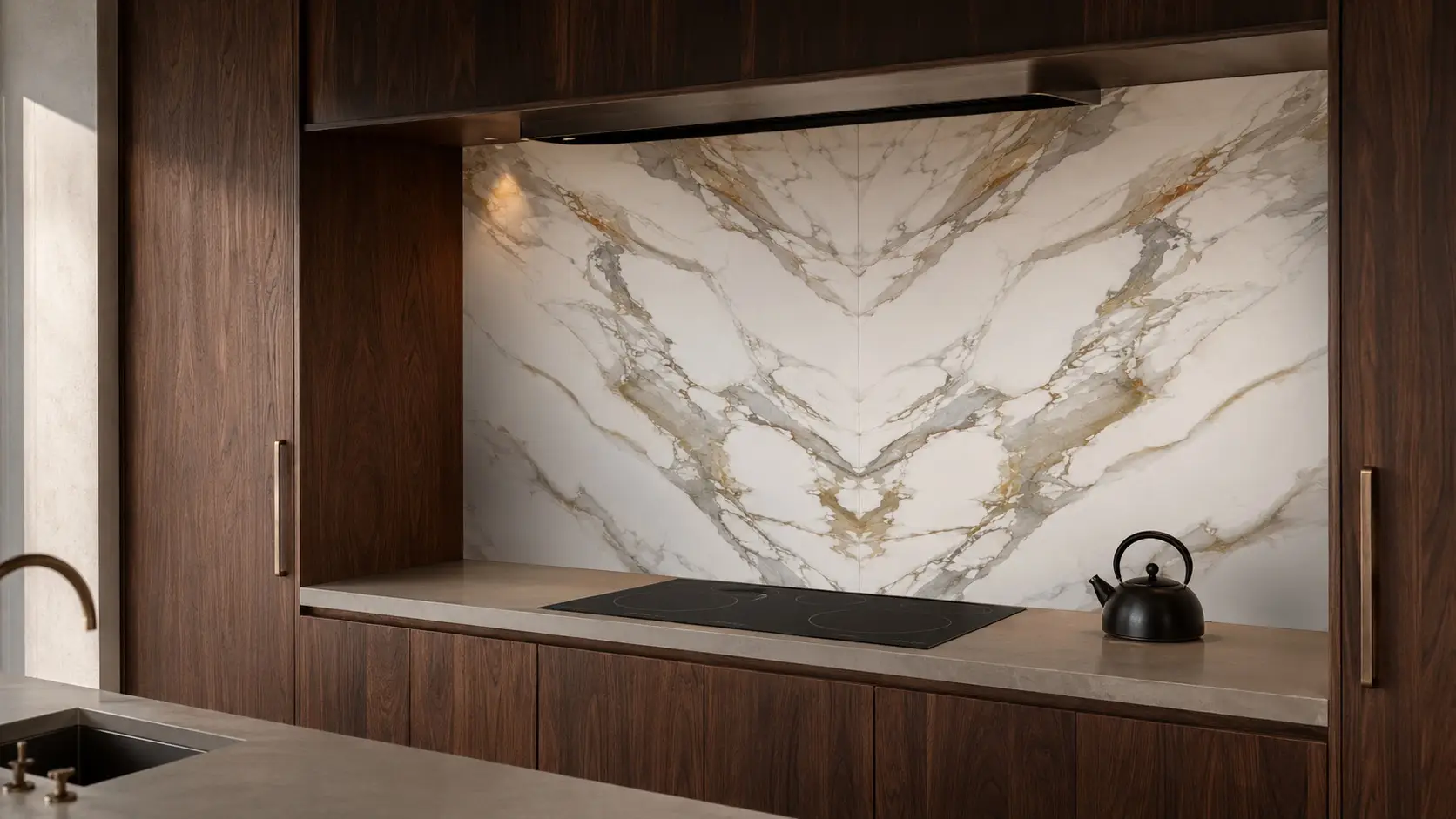
Bookmatched behind the range. Mirroring two adjacent slab faces into a symmetrical, butterfly pattern is one of the strongest moves in a modern kitchen. It turns the wall behind the cooktop into a framed panel.
-
Continuous with the counter. Running the same Calacatta Gold on the counter and up the wall lets the veining flow without a break, a calm, monolithic look that suits minimal kitchens.
-
Statement wall, quiet counter. Put a full-height Calacatta Gold slab only behind the range as the focal point, with a plainer counter and a simple return elsewhere. It is the balanced way to get the drama without covering every surface, and it keeps the hardest-working counters low-maintenance.
-
Mind where it starts and ends. Decide the start and stop points (full wall, up to the underside of the cabinets, or wrapped to an edge) before templating, because a slab cannot be nudged later the way a tile can.
The One Hard Spot: Behind the Range
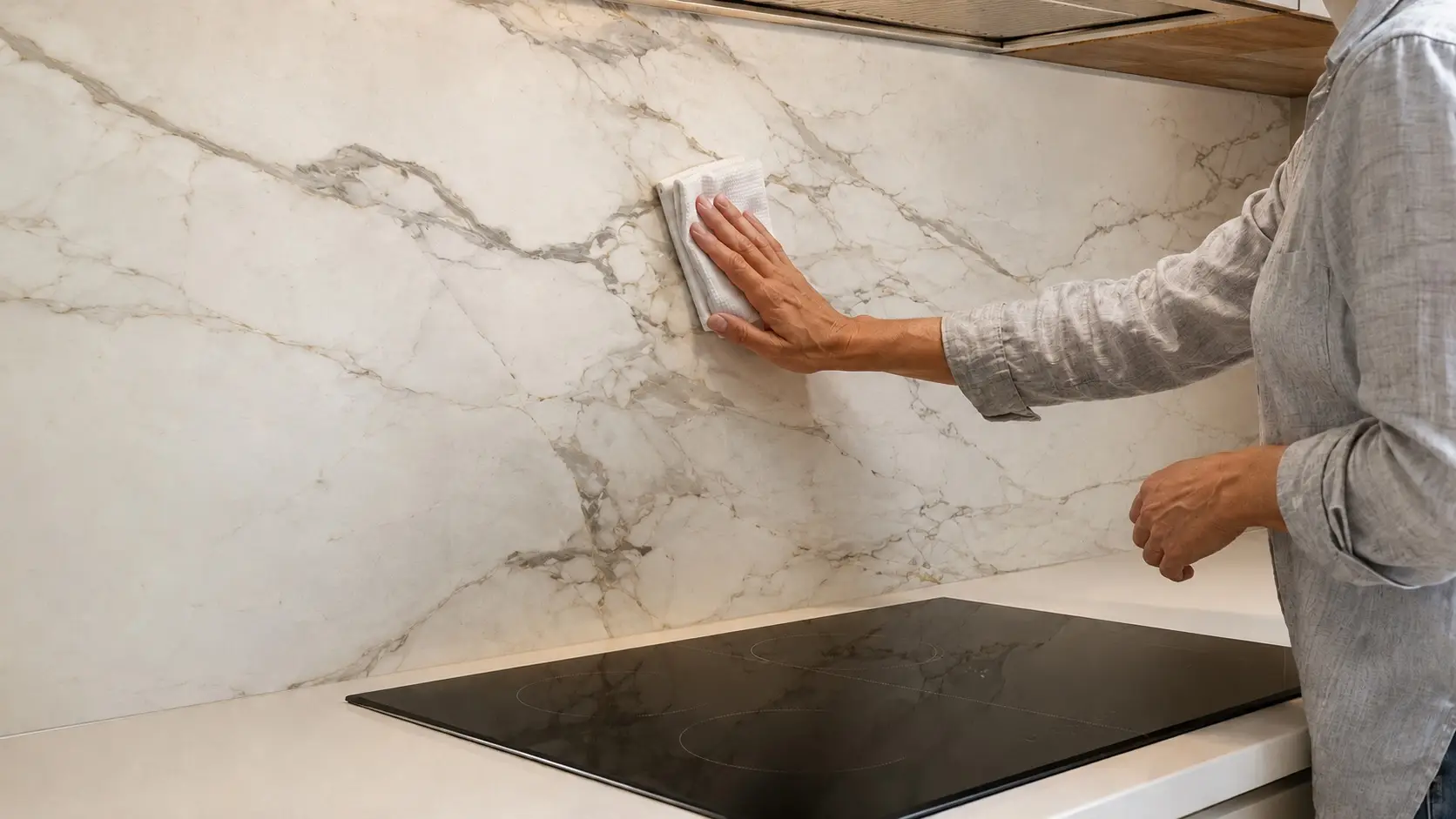
Across most of the wall, a Calacatta Gold backsplash asks very little of you, since it never meets a knife or a hot pan. The exception is directly behind the cooktop. Calacatta Gold is a natural stone made of calcite, and acids react with it: citrus, vinegar, and acidic splatter can leave a dull etch mark, and grease behind the range is best cleaned with a gentle paste and a neutral cleaner rather than left to build up. Keep the splash sealed, avoid vinegar or citrus sprays, and wipe splatter while it is fresh. One thing worth knowing: sealing slows staining but does not stop etching, because etching is a chemical reaction at the surface, not absorption. Away from the range, a backsplash rarely meets those acids, which is why it holds up so well elsewhere.
For a heavy-cooking kitchen, there is a clean compromise: run the natural stone across the main wall and use a non-porous version of the same look directly behind the cooktop. Pacific Shore Stones carries Calacatta Gold as porcelain from Atlas Plan and as an engineered surface from Silestone, both effectively non-porous, alongside the natural marble, so you can put the drama where it is admired and the workhorse where it is needed.
See Calacatta Gold in Person
Veining is the entire point of a Calacatta Gold backsplash, and no two slabs match, so it is worth choosing the piece and planning the bookmatch before anything is cut. Pacific Shore Stones carries Calacatta Gold as natural marble, as porcelain from Atlas Plan, and as an engineered surface from Silestone. Check live inventory