
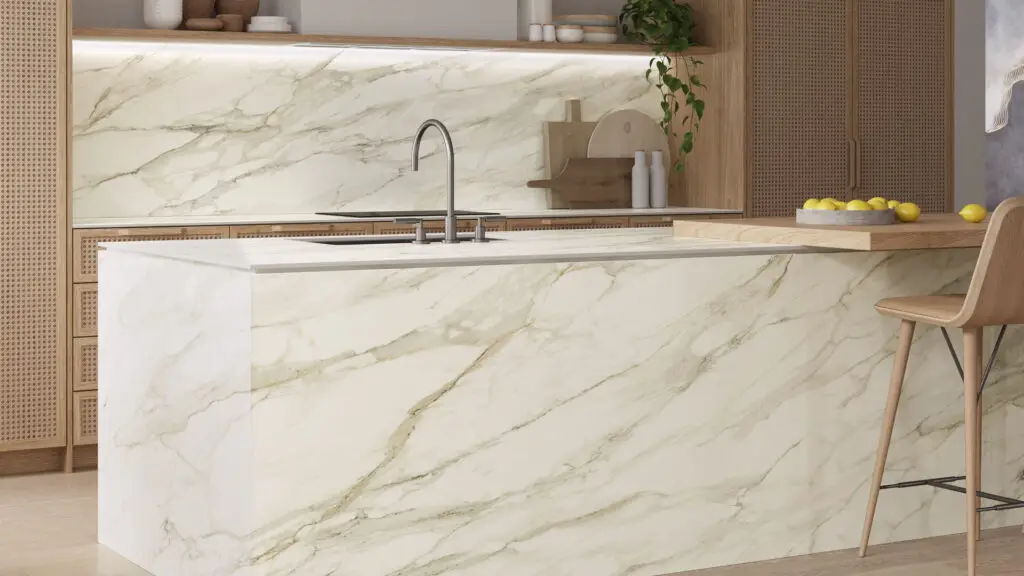
Caesarstone” today isn’t just a single product; it is a sophisticated ecosystem of surface technologies. At Pacific Shore Stones, we provide designers and homeowners access to this materials brands, ensuring the right fit for every specific countertop context.
As a premier distributor, our goal is to help you navigate these options—from high-traffic kitchen islands to high-heat outdoor cooking stations—to find the perfect Caesarstone slabs for your project.
What Caesarstone Actually Is
Caesarstone is a brand, not a single material. While many associate it exclusively with quartz, the brand has evolved into a multi-surface innovator. Understanding the composition is key to choosing the right slab at a Pacific Shore Stones showroom
Founded in Israel in 1987, Caesarstone now manufactures globally. The Caesarstone US catalog is meticulously curated and distributed by Pacific Shore Stones locations, ensuring you get authentic, high-grade material..
The Four Surface Lines
-
Quartz — the original engineered stone. The default pick for indoor kitchen countertops, bath vanities, and waterfall islands. A small subset of “Outdoor Quartz” colors is rated for shaded exterior countertops.
-
Porcelain — the sintered through-body line. Heat- and UV-resistant. The only Caesarstone countertop you can pull a hot pan onto without a trivet. Specified for outdoor kitchens, near-cooktop installs, and sunlit bathrooms.
-
Mineral — a newer hybrid engineered for higher heat tolerance than traditional quartz, while keeping the deep veining patterns of natural stone. Many Mineral colors are also offered as Quartz, so you can match across applications.
-
ICON — Caesarstone’s most recent technology, blend of innovative and recycled material
Heat & Durability: How the Lines Compare
Caesarstone publishes hardness and heat data for its Quartz and Porcelain lines:
-
Mohs hardness. Caesarstone Porcelain registers 7 on the Mohs scale, harder than granite (6) and well above marble (3).
-
Heat tolerance. Caesarstone advises against placing cookware above 300°F directly on standard Quartz, sudden temperature swings can damage the polyresin binder, so trivets are required. Porcelain handles 1,200–2,000°Fbecause it’s fired at over 2,000°F to begin with. Mineral sits between the two.
-
Water absorption. Porcelain absorbs only 0.5% of water by weight — effectively nonporous, never needs sealing.
The Seven Finishes (and Which Fits Your Countertop)
Same color, different finish, very different countertop. At Pacific Shore Stones, we emphasize that the finish changes the “read” of the color. Caesarstone’s current finishes:
-
Polished — high-gloss, reflective. Amplifies veining contrast and brightens light colors. The default for traditional kitchen countertops and statement marble-look islands.
-
Honed — matte, low-gloss. Hides fingerprints and minor toolmarks better than polished, which is why it’s become the default for contemporary kitchen perimeters and large bath vanities.
-
Silk — smooth with a soft, warm sheen — a shimmering overlay rather than a mirror. Good for powder-room vanities where polished feels too cold.
-
Stone — lightly textured, satiny embossing. Reads like weathered natural stone underhand.
-
Ultra Rough — granular, inspired by crude rocks. Rare on countertops; occasionally specified on bar tops for tactile contrast.
-
Concrete — flat industrial finish, paired with the concrete-look color family.
-
Natural — raw quartz appearance, no extra polish. The most subdued of the seven.
-
Glossy (arriving in 2026) — mirror-like, intensified reflection. Not compatible with Safe-Grip, so countertop-only.
Slab Sizes and Thicknesses
Caesarstone slabs ship in three thicknesses (1.2 cm, 2 cm, and 3 cm) and three formats: Standard (120″ × 56.5″) and two Jumbo options (124.5″ × 61.5″ and 131.5″ × 64.5″).
Jumbo matters when a countertop calls for a waterfall island or a long uninterrupted run, where a visible seam is the difference between a refined install and a compromised one.
Caring for Your Countertop
Caesarstone surfaces are nonporous and don’t need sealing, that alone simplifies maintenance compared with marble or granite. Caesarstone publishes four practices for its quartz countertops (Caesarstone):
-
Daily cleaning. Damp cloth with warm soapy water, mild detergent, or a non-abrasive spray. Dry with a soft cloth in broad circular motions.
-
Routine buildup. For fingerprints, coffee rings, and water marks, use a non-abrasive cleaner — Soft Scrub Liquid Gel, smooth cleansing cream, or gentle bleach. A 50/50 vinegar-and-water mix works as an eco alternative.
-
Stubborn stains. Caesarstone recommends a cleanser containing oxalic acid on a non-abrasive sponge. Tougher cases take rubbing alcohol, or — on lighter colors — a small amount of bleach. Oil needs a mild degreaser; dry or sticky substances scrape off with a plastic putty knife.
-
What to avoid. Harsh chemicals (oven cleaners, toilet cleaners, dishwasher polishing agents, paint removers). Direct heat above 300°F — always use a trivet, and avoid sudden temperature shifts. Sharp blades without a cutting board.
Experience Caesarstone at Pacific Shore Stones
A digital catalog cannot capture the tactile nuance of a Honed finish or the scale of a Jumbo slab. We invite you to visit a Pacific Shore Stones or Elements showroom to see these surfaces in person.
As a leading distributor with 17 locations across California, Texas, Oklahoma, Arkansas, Nevada, and Mississippi, we provide the expertise to help you select, spec, and maintain your surfaces.
Explore the Caesarstone Slabs in Our Live Inventory | Find Your Nearest Showroom