
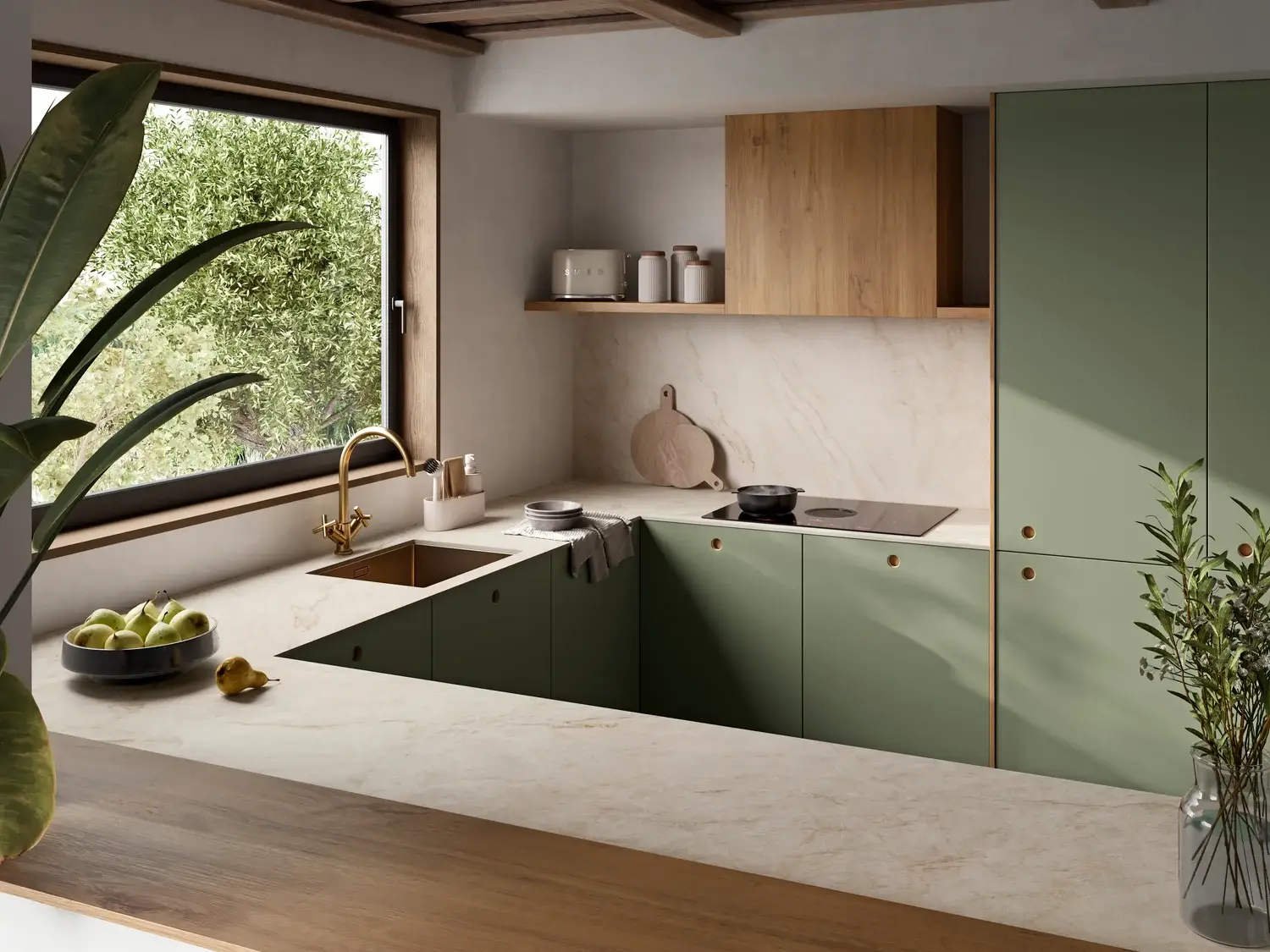
There’s a material quietly disrupting the countertop world—and most homeowners have never heard of it.
It handles hot pans directly from the stove. It never needs sealing. It’s made from 100% natural materials yet performs with engineered precision. And it’s been the secret weapon of luxury designers for years.
It’s called sintered stone. And once you understand what it offers, you might wonder why anyone still debates between granite and quartz.
This guide explains what sintered stone actually is, how it’s manufactured, what makes it different from other countertop materials, and whether it makes sense for your kitchen.
Sintered Stone: The Basics
Sintered stone is an engineered surface created by fusing natural minerals under extreme heat and pressure.
The process is fascinating: raw materials—clay, feldspar, silica, mineral oxides—are combined, compressed under 30,000+ tons of pressure, then fired at temperatures exceeding 1200°C. This extreme heat causes particles to fuse at a molecular level, creating a surface denser and harder than the individual components.
Think of it as replicating millions of years of geological formation in a controlled factory setting. The result is a material that combines natural stone aesthetics with engineered consistency.
Unlike quartz (which binds crusite minerals with synthetic resins) or natural stone (which varies from slab to slab), sintered stone uses only natural materials and delivers uniform performance across every piece produced.
How It’s Made: The Manufacturing Process
Understanding the manufacturing explains why sintered stone performs so differently.
- Material selection begins with sourcing natural stone dust, clay, feldspar, silica, and mineral oxides. These materials are chosen for durability, color, and aesthetic properties.
- Mixing and blending combines materials in precise proportions. Different combinations create different colors and patterns—this is where the artistry happens.
- Extreme compression subjects the mixed materials to 30,000+ tons of pressure, beginning the particle fusion and eliminating air pockets.
- High-temperature firing at 1200°C+ causes molecular-level fusion. The particles don’t just stick together—they become one continuous material.
- Finishing includes polishing, honing, or texturing depending on desired aesthetics, followed by edge profiling and quality inspection.
The result is a material with near-zero porosity, exceptional hardness, and complete consistency.
What Makes Sintered Stone Different
Several characteristics set sintered stone apart from other countertop materials.
- True heat resistance. Because sintered stone contains no resins or plastics—only materials already fired at extreme temperatures—it handles direct heat from cookware without damage. This is its most significant practical advantage over quartz, which can scorch or discolor under heat.
- Exceptional hardness. Rating 7-8 on the Mohs scale (harder than granite, harder than quartz), sintered stone resists scratching from knives, pots, and daily kitchen abuse.
- Non-porous surface. Near-zero water absorption means nothing penetrates. Stains, bacteria, moisture—none of it gets in. This eliminates the sealing requirements natural stone demands.
- Consistent performance. Unlike natural stone, where each slab varies and may contain hidden weaknesses, sintered stone delivers identical properties throughout. The sample represents the slab accurately.
- UV and weather resistance. Unlike many engineered surfaces, sintered stone handles outdoor exposure without fading or degradation—expanding application possibilities significantly.
Sintered Stone vs. Quartz: The Critical Differences
This comparison matters because both are premium engineered surfaces competing for the same projects.
Heat tolerance is the dividing line. Quartz contains polymer resins that can melt, discolor, or crack under high heat. Sintered stone, containing only inorganic materials, handles direct heat without concern. If you cook actively and don’t want to worry about trivets, sintered stone wins decisively.
Composition differs fundamentally. Quartz combines ground quartz crystals with synthetic binders. Sintered stone uses only natural materials fused through heat and pressure. For sustainability-minded homeowners, this distinction matters.
Hardness is comparable. Both materials resist scratching and staining effectively. Sintered stone is slightly harder, but practical performance in residential kitchens is similar.
Design variety favors sintered stone. While quartz offers good options, premium sintered stone brands provide remarkable natural stone replication and broader design ranges.
For detailed material comparisons, our guide on quartz vs. quartzite explores similar decision factors.
The Leading Sintered Stone Brands
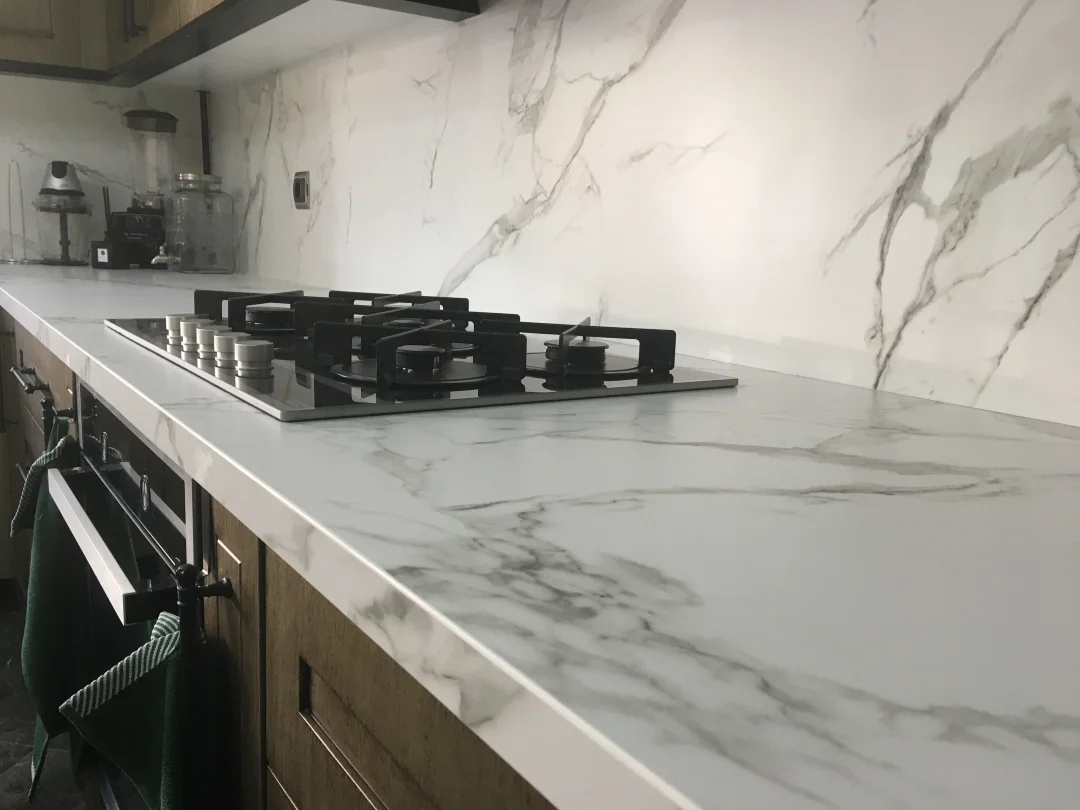
Two brands dominate the premium sintered stone market: Neolith and Dekton. Both deliver exceptional quality, but each has distinct character.
- Neolith pioneered the ultra-compact sintered stone category and remains the market leader. Spanish-manufactured, Neolith offers 100+ designs across polished, matte, and textured finishes. The brand emphasizes sustainability and design innovation, with particularly strong marble-look and contemporary options. A 25-year residential warranty reflects confidence in longevity.
- Dekton, produced by Cosentino (the company behind Silestone quartz), represents another premium option. Dekton emphasizes innovation with unique finishes and edge options, offering sophisticated designs from natural stone aesthetics to contemporary solids. The brand benefits from Cosentino’s extensive distribution network and customer support.
Choosing between them often comes down to specific design preferences and local availability. Both deliver comparable durability, heat resistance, and warranty coverage. Both are non-porous and low-maintenance. The aesthetic range differs slightly—Neolith is often perceived as more design-forward, while Dekton emphasizes technical innovation.
Pacific Shore Stones carries both brands, allowing side-by-side comparison.
Where Sintered Stone Works Best
Kitchen countertops are the primary application, but sintered stone’s versatility extends further.
- Bathroom vanities benefit from the same stain and moisture resistance that serves kitchens.
- Backsplashes can match countertops seamlessly for unified design statements.
- Flooring in high-traffic areas leverages sintered stone’s hardness and durability. Compatibility with radiant heating systems adds appeal.
- Outdoor kitchens and living spaces work beautifully because sintered stone handles UV exposure, temperature fluctuations, and weather without degradation—something many engineered surfaces can’t claim.
- Wall cladding uses sintered stone’s large-format slab capability and design variety for dramatic interior statements.
Experiencing Sintered Stone
Photos and descriptions only go so far. Sintered stone’s qualities—how light plays across different finishes, how the surface feels under your hand, how colors appear in actual lighting conditions—reveal themselves only in person.
Pacific Shore Stones carries both Neolith and Dekton, offering access to the full range of premium sintered stone options. Visit our showroom to compare brands side-by-side, coordinate with cabinetry and backsplash selections, and determine whether sintered stone fits your project.
The countertop you choose will serve your kitchen for decades. Make sure you’ve experienced the options in person before deciding.