
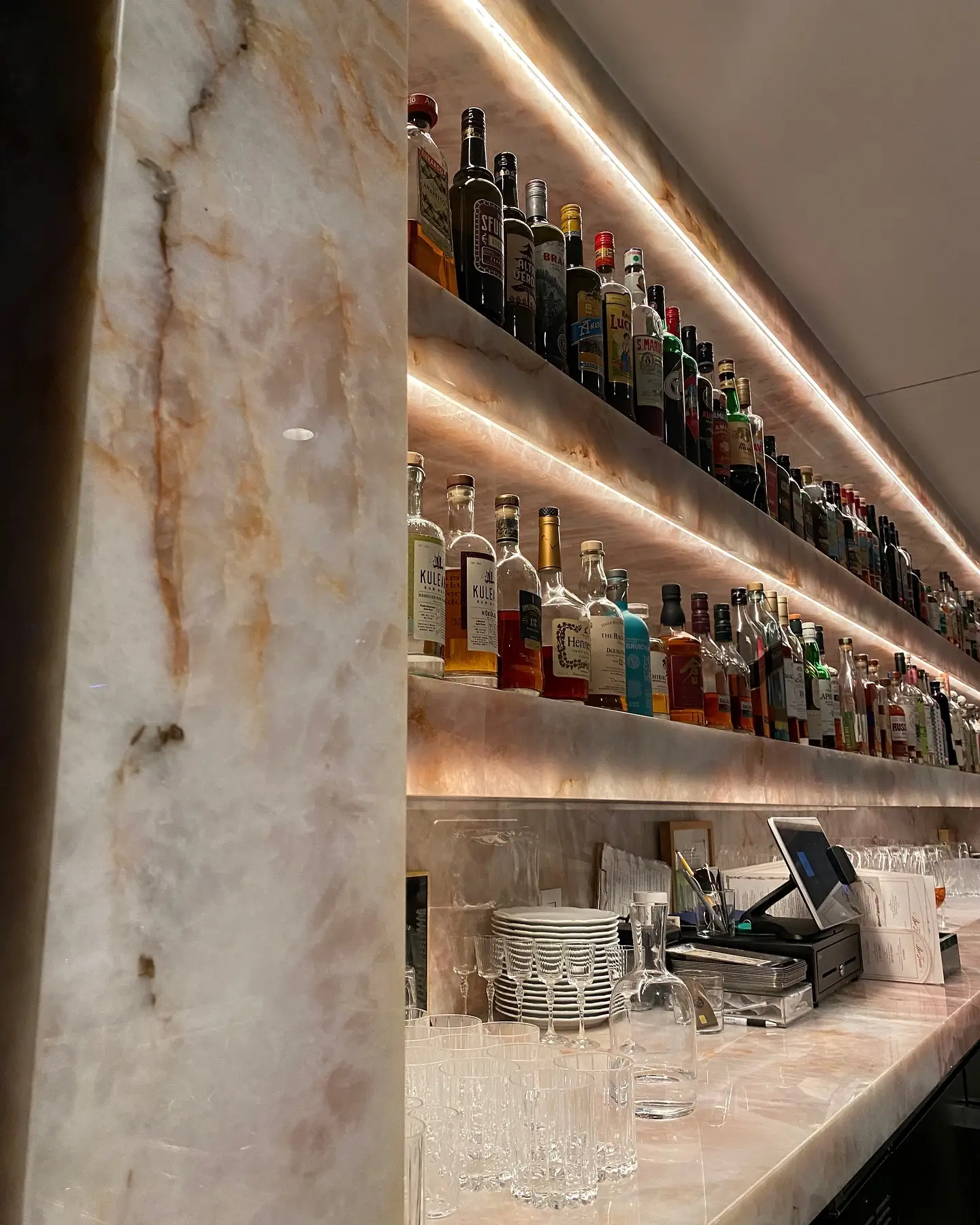
There’s something almost hypnotic about an onyx countertop. Light passes through its surface, revealing veins that look hand-painted, and suddenly you realize: this isn’t just stone. It’s a work of art that nature spent thousands of years creating.
While marble carries classic elegance and granite offers reliable strength, onyx occupies a category of its own. It doesn’t compete. It simply exists on another level, where dramatic beauty meets true exclusivity.
But does this extraordinary stone make sense for your project? That’s exactly what we’ll explore here. We’ll talk about origins, advantages, drawbacks, real costs, essential care, and that backlit effect that transforms any room. By the end, you’ll have the clarity to decide if onyx countertops are the right choice for your home.
What Makes Onyx So Special?
The story of onyx begins with water. Unlike granite, which forms deep within the earth under intense heat and pressure, onyx forms at the surface. Calcite-rich waters emerge from springs, and as they evaporate, they deposit layer upon layer of minerals. This process, documented in geological studies, takes centuries and creates something truly unique: parallel bands and swirling patterns that make every slab one of a kind.
It’s this crystalline structure that gives onyx its most striking characteristic: translucency. Light doesn’t just reflect off the surface. It penetrates, illuminates the veins from within, and creates a visual depth that no synthetic material can replicate.
And the colors? They go far beyond what you might expect. Warm honey tones, soft pinks, vibrant greens, deep reds. Each slab is a geological fingerprint, impossible to duplicate.
Why Choose Onyx Countertops? The Strengths
Let’s be direct: no one chooses onyx for practicality. The choice is aesthetic, emotional, artistic. And when you understand that, the benefits become even clearer.
Beauty that never repeats. That countertop you see in the showroom? It won’t exist in any other home in the world. Every onyx installation is unique by nature. For those who value exclusivity in design, this argument alone justifies the choice.
The magic of backlighting. Here’s the feature that truly sets onyx apart from every other natural stone. Because of its translucency, you can place LED panels behind the slab and watch the stone come alive. The veins glow. The colors deepen. A kitchen island becomes a centerpiece. A bar top becomes a conversation starter. A wall becomes art.
This isn’t just lighting. It’s transformation.
The Honest Downsides You Need to Know
Would it be fair to talk only about the magic? Of course not. Onyx has real limitations, and understanding them upfront will save you frustration later.
It’s a delicate stone. On the Mohs hardness scale, onyx rates between 3 and 4, while granite sits at 6 to 7. What does this mean in practice? Knives can scratch it. Heavy pots can chip it. Abrasive cleaners can dull its surface. This isn’t a stone for careless use.
Porosity demands attention. Like many natural stones, onyx absorbs liquids. Spill some wine or lemon juice and walk away? You might return to a permanent stain. Acidic substances can etch the surface, leaving marks that are difficult to remove. Quick cleanup isn’t optional. It’s essential.
For many homeowners, these trade-offs are worth it. But they need to be trade-offs you consciously accept, not surprises you discover after installation.
How Backlighting Actually Works
The glow you see in those stunning photos isn’t accidental. It’s engineering meeting artistry.
The process involves placing custom-fit LED light panels behind the onyx slab. These panels must be positioned precisely to ensure even illumination without hotspots or dark zones. The thickness of the slab, the opacity of specific areas, and the desired intensity all factor into the design.
This isn’t a DIY project. Professional fabricators who understand onyx’s unique properties are essential for a flawless result.
Where does backlighting work best? Think about spaces where the effect can truly shine: kitchen islands that become room centerpieces, bar tops that set the mood for entertaining, bathroom vanities that create spa-like ambiance, or wall features that turn blank surfaces into dramatic focal points.
Where Onyx Belongs in Your Home
Not every space suits onyx equally. Strategic placement protects your investment and maximizes impact.
- Statement kitchen islands: In a busy kitchen, a full onyx countertop demands constant vigilance. But as a dedicated island, more showpiece than prep station, it can thrive. Use it for serving, for display, for that moment when guests gather around and simply admire.
- Bathroom vanities and walls: his might be onyx’s ideal environment. Lower traffic means reduced risk of scratches and impacts. An onyx vanity or shower wall transforms a functional bathroom into a luxurious retreat. Every morning starts with beauty.
- Backsplashes and feature walls: Perhaps the safest application, and often the most dramatic. As a vertical surface, onyx faces no cutting boards, no hot pans, no daily wear. It simply exists as art, protected and pristine, catching light and drawing eyes.
Caring for Your Onyx Countertop
Maintenance isn’t complicated, but it is non-negotiable. A simple routine protects your investment for decades.
Daily cleaning requires only a soft cloth and a pH-neutral cleaner designed for natural stone. Skip the abrasive sponges. Forget the harsh chemicals. Gentle care preserves the surface.
Immediate spill response prevents most problems before they start. Wine, citrus, tomato sauce, anything acidic, wipe it up immediately. Don’t give it time to penetrate or etch.
Professional sealing creates an invisible barrier against moisture and stains. Have your countertop sealed upon installation, then resealed every 6 to 12 months. This single step prevents most damage.
Protective habits become second nature. Cutting boards for food prep. Trivets for hot pans. Coasters for glasses. Small actions that preserve beauty.
For deeper guidance on stone care, explore these maintenance principles that apply across natural stone surfaces.
Is an Onyx Countertop Right for You?
This question has no universal answer. It depends entirely on what you value.
If you prioritize durability and low maintenance above all else, granite or quartzite will serve you better. If you want the classic look of marble with more resilience, quartzite offers an excellent alternative.
But if you see your home as a canvas for personal expression? If you want a surface that sparks conversation and inspires awe? If you’re willing to invest in the care required to maintain a piece of natural art?
Then onyx might be exactly what you’re looking for.
We encourage you to experience this material firsthand. Photos capture beauty, but they can’t convey the way light dances through crystalline structure, the depth that reveals itself at different angles, the almost living quality of a backlit slab. Some things must be seen to be believed.
Final Thoughts
Onyx countertops aren’t for everyone. They demand more care than most surfaces. They cost more than practical alternatives. They require thoughtful placement and conscious daily habits.
But for the right homeowner, none of that matters. What matters is waking up each morning to beauty that exists nowhere else. What matters is owning a piece of geological history. What matters is the moment guests see your countertop and simply stop, captivated by something they’ve never encountered before.
That’s not a countertop. That’s a legacy.
Ready to explore the world of onyx? Visit our inventory or schedule a consultation with our stone experts at Pacific Shore Stones to find the perfect slab for your home.